
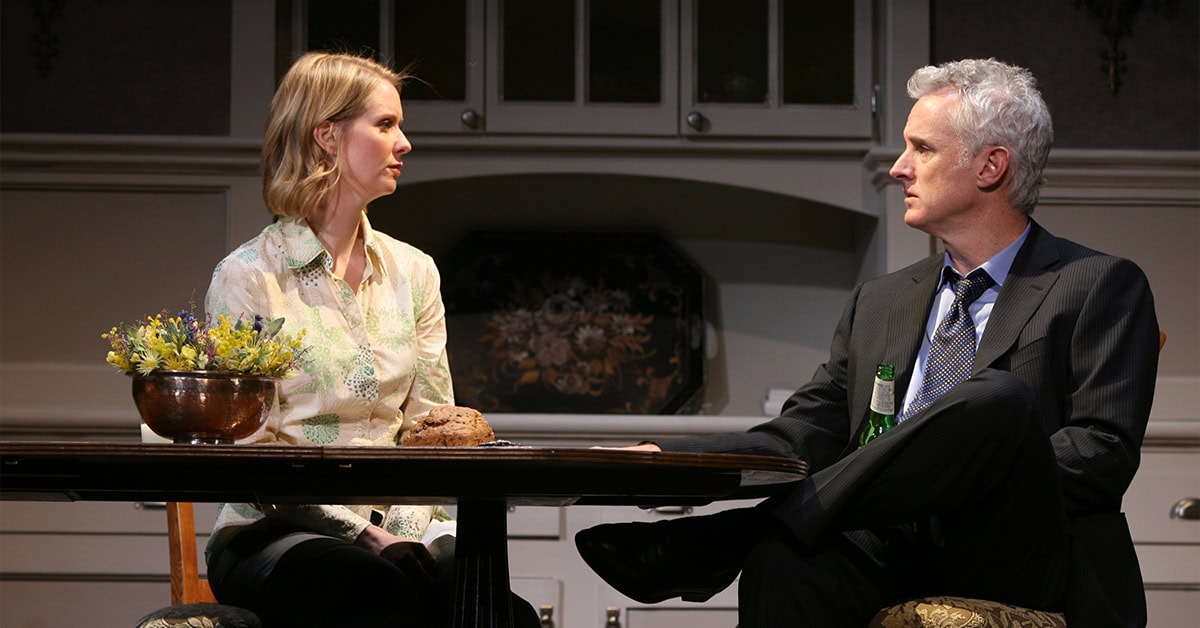
2006 Manhattan Theatre Club production of Rabbit Hole (Joan Marcus)
Many of the theatre’s greatest works plant their flag on weighty emotional terrain, examining how humanity makes sense of the great tragedies and joys of existence. In this new series, Breaking Character explores works unified around a challenging emotional or psychological concept – works that speak to serious themes with compassion, warmth and even humor.
In this first entry, Breaking Character presents a sampling of plays and musicals that speak profoundly to grief – its shattering effects, its overwhelming power, its capacity to spark renewal. Each of these shows has its own unique take on grief and its consequences. Explore the selection below and discover how grief can be the genesis of moving, challenging, rewarding art.
anthropology by Lauren Gunderson (US/UK)
(Full-Length Play, Drama / 4w)
The play: Wracked with grief, coder Merril creates an A.I. chatbot that can perfectly recreate her deceased sister Angie. But as the virtual Angie begins to demand more presence in Merril and her mother’s lives, reality and consciousness blur, and new moral questions arise about the right, safe and acceptable ways to grieve.
On Grief: As we move towards an increasingly technology-dominated future, the question of how much we can ever truly leave those we have lost in the past grows in importance. anthropology explores these questions of digital legacies and remnants of memory with Lauren Gunderson’s trademark emotional honesty. How much can we ever really grieve someone if we have the capacity to create a facsimile capable of replicating everything the outside world knew about them? What does grief mean in a world where emotional intelligence is often subservient to artificial intelligence?
Exit the King by Eugène Ionesco and Donald Watson (US/UK)
(Full-Length Play, Drama / 3w, 3m)
The play: In the crumbling throne room of a palace in an unnamed country, King Berenger has only the duration of Exit the King to live. Once, he ruled over an immense empire and commanded great armies. Now, his kingdom has shrunk to the confines of his garden wall. Here, he must face the final inevitable truth of life: death.
On Grief: Absurdist theatre is marked by its fascination with the meaning, or lack of meaning, that comprises the end of life. Ionesco was a titan of the genre, and in this thrilling translation from Donald Watson, the more surreal aspects of grief are brought to the fore. Ashes to ashes, dust to dust, goes the old saying, and Exit the King is primarily concerned with the inevitability of that phrase. We will all grieve, it suggests, and we must all come to terms with our personal way of grieving.
Fun Home by Jeanine Tesori and Lisa Kron, based on the graphic novel by Alison Bechdel (US/UK)
(Full-Length Musical, Drama / 4w, 2m, 1 girl, 2 boys)
The play: When her father dies unexpectedly, graphic novelist Alison dives deep into her past to tell the story of the volatile, brilliant, one-of-a-kind man whose temperament and secrets defined her family and her life. Moving between past and present, Alison relives her unique childhood playing at the family’s Bechdel Funeral Home.
On Grief: How do you mourn someone whose presence looms large over every facet of your life – and not always for the better? That is the question posed by the enchanting and extraordinary Fun Home, where the loss of a father does not immediately sanitize the many painful memories of his existence. Moving with incredible grace from grief to sexuality to adolescence to repression and more, Fun Home is an exploration of grief that never glosses over the fact that it is a process that can take years, if not decades.
Furlough’s Paradise by a.k. payne (US/UK)
(Full-Length Play, Drama / 2w)
The play: Cousins Sade and Mina used to be inseparable. Now leading very different lives, they return to their childhood town for the funeral of their mother and aunt. While Sade is on a three-day furlough from prison and Mina experiences a brief reprieve from her career and life on the West Coast, the two try to make sense of grief, home, love and kinship.
On Grief: Lyrical and expansive, a.k. payne’s incredibly modern play explores grief as a starting point for new beginnings and possibly even new utopias. In the playwright’s own words, grief in the play is intertwined with ideas of abolition, of the ending of one system and the birth of another. Grief has, one hopes, an eventual endpoint, and payne examines how grief can become a process of moving forward into a future of your own conception. Here, grief is not a static state of affairs. It takes you to, and through, new places.
Grief Hotel by Liza Birkenmeier (US/UK)
(Full-Length Play, Dark Comedy / 3w, 2m, 1gnc)
The play: News of a missing acquaintance brings old friends (and ex-lovers) back together. Relationships re-form around natural and unnatural disasters, and everyone ends up at Aunt Bobbi’s house, even though her parties are cursed. Loss is fast, but grief is slow.
On Grief: To quote Grief Hotel’s own Aunt Bobbi, a grief hotel is a place where “you get a luxury bespoke healing experience that is cut off from the obligations you would otherwise have, and so you are able to get better a new way.” Exploring the commodification of grief with sharp wit and memorable characters, Liza Birkenmeier’s work questions the desire to make universal human experiences universally experiential. Grief is a messy process. It causes people to lash out, to yell, to sulk, to chastise. It cannot be so easily contained.
Letters From Max by Sarah Ruhl, based on correspondence with Max Ritvo (US/UK)
(Full-Length Play, Drama / 1w, 1m)
The play: Sarah and her former student Max share letters and poems candidly addressing his terminal illness with humor and lyricism in this communal, theatrical version of her novel of the same name.
On Grief: Throughout history, artists have sought to turn their own tragedies into art. In this intensely personal play, Sarah Ruhl transforms her own relationship with her former student Max Ritvo into a work of stunning power. Called “a theatrical act of remembrance and a sacrament of grief” by The New York Times, Letters from Max is a testament to art’s value as a means of processing traumatic events. The creation of work that stems from grief can be its own powerful way of memorializing a life for eternity.
Marjorie Prime by Jordan Harrison (US/UK)
(Full-Length Play, Drama / 2w, 2m)
The play: It’s the age of artificial intelligence, and 85-year-old Marjorie – a jumble of disparate, fading memories – has a handsome new companion who’s programmed to feed the story of her life back to her. What would we remember, and what would we forget, if given the chance? In this richly spare, wondrous new play, Jordan Harrison explores the mysteries of human identity and the limits – if any – of what technology can replace.
On Grief: Memory is often the connective tissue in times of grief, and this tenet “animates Jordan Harrison’s subtly shattering play” (Chicago Sun-Times) by exploring how and why people might turn to AI to make sense of loss and/or cope with it in the aftermath.
Moon Man Walk by James Ijames (US)
(Full-Length Play, Drama / 2w, 2m)
The play: Upon hearing about the sudden death of his mother, Spencer returns to Philadelphia to plan her funeral. Along the way he falls in love, discovers the truth about his absent father and learns that his past is also the making of his present. This magical journey through space and time takes us literally from Philadelphia to the moon and back.
On Grief: Moon Man Walk’s epigraph comes from Carl Sagan: “we are all made from star stuff.” The play grapples with all the things that take on a galaxy-sized importance at some point in human existence: parental figures, love and grief. Starting with a scene set nominally somewhere in the cosmos, James Ijames’s sweetly touching play is a tribute to powerful mothers and the void that their absence can leave. In grieving, Spencer finds ways to fill that void, and grief is presented as an emotional space that can be filled with transportive, outsize feelings.
Mothers and Sons by Terrence McNally (US)
(Full-Length Play, Drama / 1w, 2m, 1 boy)
The play: A woman pays an unexpected visit to the New York apartment of her late son’s partner, who is now married to another man and has a young son, causing her to grapple with grief and the life her son may have led.
On Grief: Mothers and Sons, a characteristically moving and resonant play from Terrence McNally, explores grief not only for someone who has been lost, but for the secrets and untold stories their life may have contained. The suddenness of death is not only a tragedy in the sense that it takes something or someone away, but also that it reveals all the ways that relationships may have been more strained that they seemed. Mothers and Sons approaches grief in its totality and tracks the consequences that spiral outwards from it.
Rabbit Hole by David Lindsay-Abaire (US)
(Full-Length Play, Drama / 3w, 2m)
The play: Becca and Howie Corbett have everything a family could want, until a life-shattering accident turns their world upside down and leaves the couple drifting perilously apart.
On Grief: The inclination when faced with grief is to immediately figure out how to move on from it, whether by removing every trace of it from one’s mind or by obsessively fixating on what could have been done to prevent the tragedy. Rabbit Hole presents both sides of this horrible duality. David Lindsay-Abaire’s magnificent play, which won the Pulitzer Prize for Drama, focuses on how people try to eliminate all traces of grief from their lives, how they try to present an impenetrable face to the world, and how they fall apart when faced with the impossibility of moving past grief. It also does so while maintaining the playwright’s characteristic warm humor. Here, grief moves slowly but inexorably towards its antidotes – love and hope.
She Kills Monsters by Qui Nguyen (US/UK)
(Full-Length Play, Dramatic Comedy / 6w, 4m)
The play: Agnes Evans leaves her childhood home in Ohio following the death of her teenage sister, Tilly. When Agnes finds Tilly’s Dungeons & Dragons notebook, she finds herself catapulted into a journey of discovery and action-packed adventure in the imaginary world that was her sister’s refuge.
On Grief: Full of nasty ogres, homicidal fairies and 90s pop culture, She Kills Monsters fashions a charming, high-octane, heart-pounding hero’s journey out of a response to grief. Agnes’ discovery of her sister’s constructed world presents grief as a means of becoming closer to her sister and a truer legacy of her memory. In Qui Nguyen’s incredibly vivid world, the loss of a loved one can be a means of discovering exactly what made them so special.
The Secret Garden by Marsha Norman and Lucy Simon (US/UK)
(Full-Length Musical, Drama / 10w, 12m, 1 girl, 1 boy + ensemble)
The play: The enchanting, Tony Award-winning musical based on Frances Hodgson Burnett’s 1911 novel is a compelling tale of forgiveness and renewal. Orphaned in India, 11-year-old Mary Lennox returns to Yorkshire to live with her embittered, reclusive uncle Archibald and his son Colin. The estate’s many wonders include a magic garden which beckons the children with haunting melodies and the “Dreamers,” spirits from Mary’s past.
On Grief: The Secret Garden engages meaningfully with the specific way in which children process grief. Through the musical’s heroine, Mary, fantastical worlds and ghostly spirits are uncovered and serve as a means for growth. Mary transforms her grief into tangible work, helping to restore the garden and allow her and her uncle’s memories to be freed. Never losing its sense of childlike wonder even as it explores adult themes, The Secret Garden captures what it means to grieve at a young age.
You Are Cordially Invited to the End of the World! by Keiko Green (US/UK)
(Full-Length Play, Dramatic Comedy / 3w, 2m, 1gnc)
The play: Greg’s received a terminal diagnosis. At least he’s in good company – the planet’s on its last legs, too. Coincidence? Not for Greg. After all, the world’s too big not to be kind of magical.
On Grief: A sparkling, vibrant meditation on the weight of grief moderated by a captivating MC, You Are Cordially Invited to the End of the World portrays grief in all its outsize importance. In this piece, humor and catharsis provides the a method of engaging with grief that takes care of those who relate to losing a loved one to terminal illness. Keiko Green’s ever-delightful work finds a sense of freedom even as the world might be collapsing and presents a theatrical odyssey where panic (justified) and partying (needed) do not have to be mutually exclusive.
For more moving and powerful plays, visit Concord Theatricals in the US or UK!
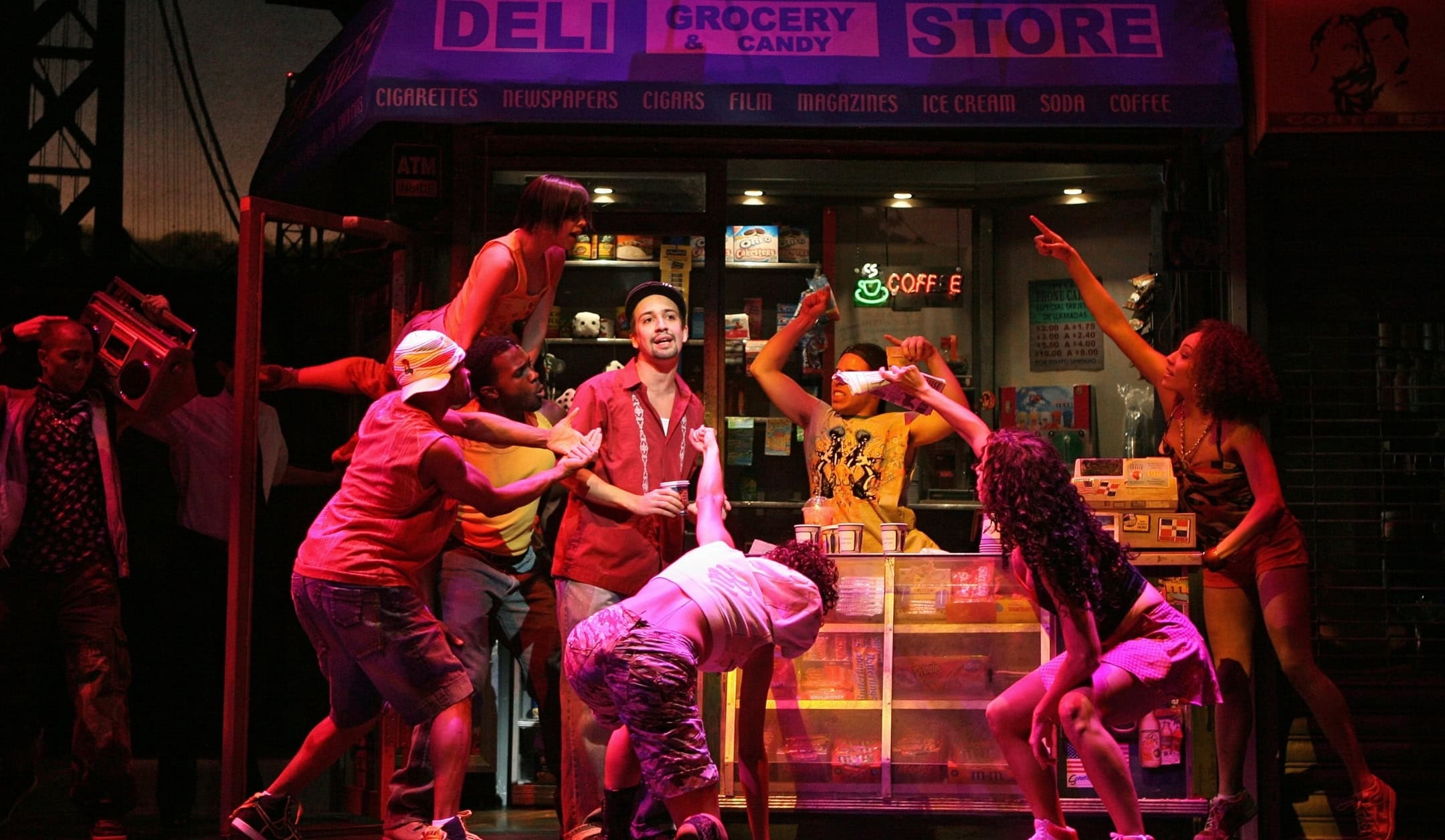
Shows for Every Audience
Warm and inviting, these shows are an accessible way to experience the magic of live theatre. For any age and any background, they’re sure to delight audiences and give actors a chance to shine.

Thank You, Teachers
To honor the wonderful educators who motivate young theatre artists, Concord Theatricals authors thank their most inspiring teachers.
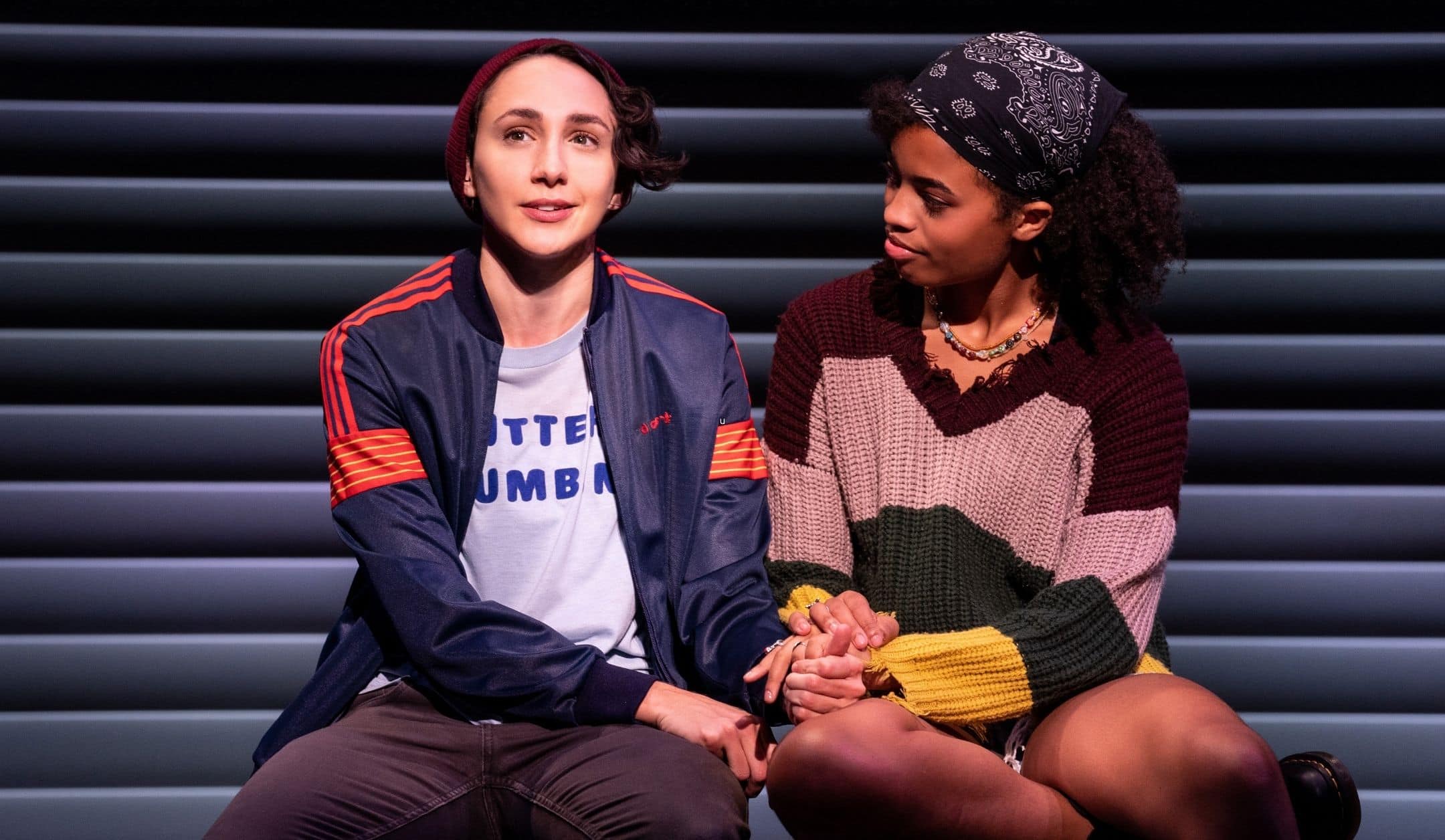
College Theatre: Consider These Plays & Musicals, Fall 2026
Choose your next show from this wide selection of plays and musicals for colleges and universities, including incisive political dramas, charming rom coms and cutting-edge musicals.