
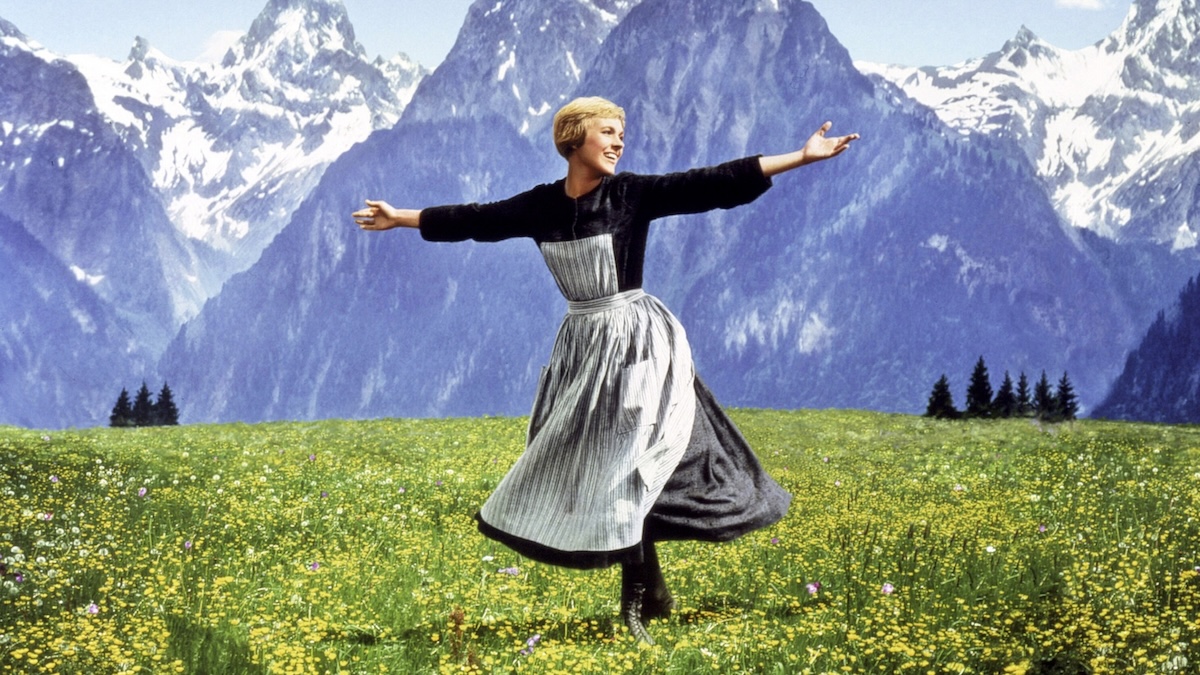
The Sound of Music, 1965 Oscar winner for Best Picture (Photo credit: Rodgers & Hammerstein/20th Century Fox)
Hollywood and Broadway have always had a symbiotic relationship. Plays become movies and movies become musicals, and sometimes they become movies again. Whether inspiring storied adaptations or bringing a decorated script to the stage, these shows have that touch of Hollywood magic. Here’s a list of Concord Theatricals plays and musicals that won the Academy Award for Best Picture.
BEST PICTURE 1932/33: Cavalcade
Cavalcade by Noël Coward (UK)
(Full-Length Play, Drama / 18w, 18m, 2 girls, 2 boys + ensemble)
Filled with grand spectacle and a wide-ranging overview of the entire span of the 20th-century up until the time of its creation, Cavalcade was Noël Coward’s most ambitious stage project. Presenting the lives of an upper-middle-class British family, the Marryots, as they experience a turbulent and moving quarter-century, the play travels from the Relief of Mafeking and the death of Queen Victoria to the sinking of the RMS Titanic and World War I. The play’s even more grandiose film adaptation, starring Diana Wynyard and Clive Brook, won Best Picture at the 6th Oscars and is a marvel of technical and artistic achievement.
BEST PICTURE 1938: You Can’t Take It With You
You Can’t Take It With You by Moss Hart and George S. Kaufman (US)
(Full-Length Play, Comedy / 7w, 9m, 3 any gender)
The family of Martin Vanderhof lives “just around the corner from Columbia University – but don’t go looking for it.” Grandpa, as Martin is more commonly known, is the head of a large and extended family of charming eccentrics. His granddaughter, Alice, is a loving young woman who is nonetheless still embarrassed by her family’s idiosyncrasies. When Alice falls for Tony, a handsome scion of Wall Street, she fears that their two families – so unlike in manner, politics and finances – will never come together. But why be obsessed by money? After all, you can’t take it with you.
You Can’t Take It With You opened on Broadway in 1936, with a cast led by Henry Travers as Grandpa. The play was awarded the 1937 Pulitzer Prize for Drama and spawned a major motion picture starring Lionel Barrymore as the patriarch, with direction by Frank Capra, who won an Oscar on top of the film’s 1938 Best Picture win.
BEST PICTURE 1940: Rebecca
Rebecca by Daphne du Maurier (US/UK)
(Full-Length Play, Drama / 3w, 8m + ensemble)
Daphne du Maurier’s own stage adaptation of her thrilling and psychologically inquisitive novel, later adapted into a Best Picture-winning Alfred Hitchcock masterpiece, is the tale of Max de Winter, his new wife, and the ghost of his previous one.
When Max brings his new young bride to Manderley, his great estate in Cornwall, she senses the overpowering presence of Rebecca, Max’s drowned wife, everywhere. Even more so because Mrs. Danvers, the grim housekeeper, will not allow her to forget how she pales in comparison. Full of thrills and chills, Rebecca remains one of the great gothic noirs in film and stage history.
BEST PICTURE 1949: All the King’s Men
All the King’s Men by Robert Penn Warren (US)
(Full-Length Play, Drama / 4w, 14m)
All the King’s Men follows the dramatic rise and fall of inciter and fictional Southern politician Willie Stark — who resembles the real-life Huey Long of Louisiana, the state’s 40th governor. Stark begins his career as an idealistic man for the people, but he soon becomes overtaken by a desire for power.
Based on Robert Penn Warren’s 1947 Pulitzer Prize-winning novel, All the King’s Men was adapted into the 1949 Oscar-winning Best Picture, starring Broderick Crawford in an Oscar-winning turn as Stark. Later came Warren’s acclaimed stage adaptation, which had a highly successful off-Broadway run in 1959.
BEST PICTURE 1950: All About Eve
Applause by Betty Comden, Adolph Green, Charles Strouse and Lee Adams (US/UK)
(Full-Length Musical, Dramatic Comedy / 4w, 4m)
With sass, wit and a pulsing 1970s score, Applause presents showbiz in all its glory and ferocity. A musical version of the film All About Eve, it concerns superstar Margo Channing and her ambitious, scheming assistant, Eve Harrington. The musical’s hit songs include “But Alive,” “Applause,” “Welcome to the Theater” and “Something Greater.”
Applause opened on Broadway at the Palace Theatre in 1970, starring Lauren Bacall and Penny Fuller; Bonnie Franklin sang the title song. The production won four Tony Awards, including Best Musical. All About Eve, which arrived in cinemas two decades earlier, in 1950, starred Bette Davis and Anne Baxter — and was a hit with critics and audiences, taking home six Academy Awards, including Best Picture.
BEST PICTURE 1951: An American in Paris
An American in Paris by George and Ira Gershwin and Craig Lucas (US/UK)
(Full-Length Musical, Dramatic Comedy / 4w, 5m + ensemble)
Set in the French capital in the wake of World War II, An American in Paris tells the romantic story of a young American soldier, a beautiful French girl and an indomitable European city — each yearning for a new beginning in the aftermath of international conflict. The Academy Award-winning 1951 film was directed by Vincente Minnelli and starred Gene Kelly and Leslie Caron.
The stage musical debuted on Broadway in 2015, led by veteran dancers Robert Fairchild and Leanne Cope in Tony-nominated Broadway debuts. The show features a ravishing score of Gershwin classics — such as “I Got Rhythm,” “’S Wonderful,” “Shall We Dance?” and “(I’ll Build a) Stairway to Paradise” — and a fresh, sophisticated book by Tony nominee and Pulitzer Prize finalist Craig Lucas. An American in Paris won four 2015 Tony Awards and led to a successful West End production and US national tour.
BEST PICTURE 1956: Around the World in Eighty Days
Around the World in Eighty Days by Annemarie Lewis Thomas and Phil Willmott (US/UK)
(Full-Length Musical, Comedy / 1w, 10m, 5 any gender)
Freely adapted from the adventure novel by Jules Verne, set in 1883, this delightful musical tells the story of Phileas Fogg and his servant, Jean Passepartout, as they embark on a whistle-stop journey to satisfy a wager that they can circumnavigate the world in 80 days. With bandits in pursuit, nasty villains around every corner and transport problems that force them to continue via hot air balloon (and performing elephant), will they make the deadline?
Verne’s novel was adapted for the screen in 1956, in an epic motion picture that was awarded five Oscars, including Best Picture and Best Director for Michael Anderson. A colorful wide-screen extravaganza, the film starred David Niven, Robert Newton and Shirley MacLaine, with Mexican superstar Cantinflas making a rare English film appearance as Passepartout.
BEST PICTURE 1958: Gigi
Gigi by Alan Jay Lerner and Frederick Loewe (US/UK)
(Full-Length Musical, Comedy / 3w, 5m)
In the elegant atmosphere of Paris in the 1890s, a wealthy and handsome aristocrat named Gaston falls for Gigi, a young and innocent girl raised to be a courtesan. The MGM motion picture, directed by Vincente Minnelli, premiered in 1958, starring Leslie Caron, Louis Jordan, Maurice Chevalier and Hermione Gingold. The film won all nine Academy Awards for which it was nominated.
In 1973, Gigi made its debut as a Broadway musical, starring Karin Wolfe, Daniel Massey, Alfred Drake and Maria Karnilova. The musical was honored with a 1974 Tony Award for Alan Jay Lerner and Frederick Loewe’s lively score. Gigi was revived on Broadway to positive reception in 2015, starring Vanessa Hudgens, Corey Cott, Howard McGillin and Victoria Clark.
BEST PICTURE 1959: Ben Hur
Ben Hur by Patrick Barlow (US/UK)
(Full-Length Play, Comedy / 1w, 3m)
One of the best selling books of the 19th century, Ben Hur is the epic tale of the fictional Jewish prince and merchant Judah Ben-Hur, who falls to galley slave and rises to champion charioteer in Jerusalem during the life of Jesus Christ. The 1959 film adaptation, a massive big-budget epic, starred Charlton Heston in the title role. With 11 1960 Oscar wins, the film is tied as the winner of the most Academy Awards in history.
In Patrick Barlow’s hilarious stage play, a tiny amateur theatre troupe attempts to produce the massive tale, and the actors struggle along through the piece as rivalries form and offstage romances interfere. This stage version, condensed for a cast of just four actors, premiered at the Watermill Theatre in Newbury, UK, in 2012, under the co-direction of Sean Foley and playwright Patrick Barlow. Gamely presenting a chariot race, a sea battle and stage combat, Barlow weaves the compressed style popularized by his 39 Steps (US/UK) into one of the largest stories ever told.
BEST PICTURE 1960: The Apartment
Promises, Promises by Neil Simon, Burt Bacharach and Hal David (US/UK)
(Full-Length Musical, Dramatic Comedy / 2w, 3m + ensemble)
In New York City in the 1960s, an ambitious accountant named Chuck Baxter lends out his apartment to his supervisors, who need a discreet place for illicit afternoon rendezvous. Miserable and exploited, Chuck finds a beacon of hope in coworker Fran, who is trapped in a romantic predicament of her own.
Adapted from Billy Wilder’s five-time 1961 Oscar-winning film The Apartment, headlined by Jack Lemmon and Shirley MacLaine, Promises, Promises opened on Broadway in 1968, starring Jerry Orbach and Jill O’Hara as the romantic leads. The groovy Bacharach/David score includes the hits “Whoever You Are” and “I’ll Never Fall in Love Again.” It was revived on Broadway in 2010 with celebrated turns by Sean Hayes and Kristin Chenoweth.
BEST PICTURE 1965: The Sound of Music
The Sound of Music by Richard Rodgers, Oscar Hammerstein II, Howard Lindsay and Russel Crouse (US/UK)
(Full-Length Musical, Dramatic Comedy / 7w, 4m, 5 girls, 2 boys + ensemble)
The final collaboration between Rodgers & Hammerstein, this inspirational story, based on the memoir of Maria von Trapp, follows the charming, irrepressible governess to the seven children of the imperious Captain von Trapp, who brings music and joy to their staid household. But as the forces of Nazism take hold of Austria, Maria and the entire von Trapp family must make a moral decision.
Featuring cherished songs including “My Favorite Things,” “Do-Re-Mi,” “Sixteen Going on Seventeen” and the title number, The Sound of Music won the hearts of audiences worldwide when it opened on Broadway, earning five 1960 Tony Awards, including a prize for Mary Martin’s turn as Maria von Trapp and the Tony for Best Musical. The 1965 film, which starred Julie Andrews in an Academy Award-nominated performance as Maria, took home five Oscars, including Best Picture, and is one of the most beloved films in cinema history.
Also available for theatrical licensing: The Sound of Music: Youth Edition (US/UK).
BEST PICTURE 1966: A Man for All Seasons
A Man for All Seasons by Robert Bolt (US/UK)
(Full-Length Play, Drama / 3w, 10m)
This tragic historical drama offers a brilliant portrait of Sir Thomas More, who stood up to King Henry VIII when the King rejected the Roman Catholic Church in order to obtain a divorce and then remarry. The theatrical version debuted at the Globe Theatre in London in 1960 under the direction of Noel Willman, with Paul Scofield starring as More, a performance he reprised on Broadway to Tony-winning effect in 1961. A Man for All Seasons also won the Tony for Best Play.
The film adaptation was a favorite at the 1967 Academy Awards, taking home six Oscars, including one for Scofield’s continuing screen turn as Sir Thomas More and a prize for Fred Zinnemann as director of the film, which was also honored as Best Picture.
BEST PICTURE 1967: In the Heat of the Night
John Ball’s In the Heat of the Night by Matt Pelfrey (US)
(Full-Length Play, Drama / 2w, 8m)
Based on the acclaimed 1965 novel by John Ball, In the Heat of the Night is set in 1962 during a hot August night in the small town of Argo, Alabama, where a dead white man is discovered, and a local police officer, Bill Gillespie, arrests a Black stranger named Virgil Tibbs, who turns out to be a homicide detective from California. Tibbs soon becomes the racially tense community’s single hope in solving a brutal murder that has yielded no witnesses, no motives and no clues.
In 1967, In the Heat of the Night was made into a motion picture starring Sidney Poitier as Tibbs and Rod Steiger as Gillespie. The film triumphed at the 1968 Academy Awards, taking home five Oscars, including Best Picture. Two decades later, In the Heat of the Night was made into a TV series starring Howard E. Rollins Jr. as Tibbs and Carroll O’Connor in an Emmy Award-winning turn as Gillespie. The series ran for seven seasons. This theatrical adaptation from playwright Matt Pelfrey made its world premiere in a celebrated production from Godlight Theatre Company at off-Broadway’s 59E59 Theaters in 2010. Joe Tantalo directed a cast led by Sean Phillips as Tibbs and Gregory Konow as Gillespie.
BEST PICTURE 1975: One Flew Over the Cuckoo’s Nest
One Flew Over the Cuckoo’s Nest by Dale Wasserman (US/UK)
(Full-Length Play, Dramatic Comedy / 4w, 13m)
This stage adaptation of Ken Kesey’s celebrated 1962 novel explores unforgettable characters, including the charming and rebellious Randall McMurphy. After being convicted of a petty crime, McMurphy contrives to serve his short sentence in an airy mental institution rather than in a prison. This, he soon learns, was a mistake. He immediately clashes with the authoritarian head nurse, Nurse Ratched. Despite Ratched’s strict reign, McMurphy quickly takes over the yard, leading others out of introversion, staging a revolt so that they can see the World Series on television, and arranging a rollicking midnight party with liquor and women. But McMurphy’s brash insubordination will have its consequences.
The stage play of One Flew Over the Cuckoo’s Nest premiered on Broadway in 1963. The production starred Kirk Douglas as McMurphy and Joan Tetzel as Nurse Ratched. It was followed by a 1975 film version, which was honored with five Oscars, including one for Jack Nicholson’s turn as McMurphy, Louise Fletcher’s performance as Nurse Ratched and the award for Best Picture. In 2020, television filmmaker Ryan Murphy offered a fresh examination of Nurse Ratched in the miniseries Ratched starring Sarah Paulson.
BEST PICTURE 1981: Chariots of Fire
Chariots of Fire by Mike Bartlett (US/UK)
(Full-Length Play, Drama / 3w, 9m + ensemble)
Set in 1924 around the time of the Paris Olympic Games, Chariots of Fire follows two young track athletes who live for the beautiful purity of running and prevail in the face of overwhelming odds: Eric Liddell, a devout Scottish Christian, who runs for the glory of God, and Harold Abraham, the son of an immigrant Lithuanian Jew, whose ambition is to overcome prejudice.
Chariots of Fire was first a 1981 film — headlined by Ben Cross as Abrahams and Ian Charleston as Liddell — winning four 1982 Oscars, including the award for Best Picture. The stage play premiered at London’s Hampstead Theatre in 2012. Following critical acclaim, it transferred to the West End’s Gielgud Theatre. Directed by Edward Hall, the production featured Jack Lowden as Charleston and James McArdle as Abrahams.
BEST PICTURE 1983: Terms of Endearment
Terms of Endearment by Dan Gordon (US)
(Full-Length Play, Drama / 3w, 3m)
Challenges in life and love test the resilience of a mother-daughter relationship in Dan Gordon’s adaptation of Terms of Endearment, based on the book by Pulitzer Prize-winner Larry McMurtry and James L. Brooks’s screenplay for the Oscar-winning film. Though Emma is often exasperated by her highly-opinionated mother, Aurora, they talk every day about their problems, from Aurora finding unexpected love even as she becomes a reluctant grandmother, to Emma’s struggle in her troubled marriage. But when they need one another most, will they be able to find courage in each other?
Capturing the delicate, sometimes fractured bonds between mothers and daughters, husbands and wives, and lovers, both old and new, Terms of Endearment debuted off-Broadway at 59E59 Theaters in 2016, in a celebrated production starring Molly Ringwald. Its predecessor was greatly lauded at the 1984 Academy Awards, winning five awards, including Best Picture, Best Actress for Shirley MacLaine and Best Supporting Actor for Jack Nicholson.
BEST PICTURE 1984: Amadeus
Amadeus by Peter Shaffer (US/UK)
(Full-Length Play, Drama / 3w, 12m)
In the court of the Austrian Emperor Joseph II, Antonio Salieri has given himself to God so that he might realize his sole ambition as a composer. Yet he soon meets the greatest musical success of all time: Wolfgang Amadeus Mozart, a foul-mouthed, graceless oaf who possesses something that is beyond Salieri’s envious grasp: genius.
Peter Shaffer’s play Amadeus premiered at London’s National Theatre in 1979, with Simon Callow starring as Mozart alongside Paul Scofield as Salieri. In 1980, the production transferred to Broadway, headlined by Tim Curry as Mozart and Ian McKellen in a Tony-winning turn as Salieri.
A 1984 big-screen version starred Tom Hulce in an Oscar-nominated turn as Mozart and F. Murray Abraham in an Oscar-winning performance as Salieri. The celebrated film took home eight Oscars total, including a prize for Shaffer’s own adapted screenplay and the top award of Best Picture.
BEST PICTURE 1989: Driving Miss Daisy
Driving Miss Daisy by Alfred Uhry (US)
(Full-Length Play, Drama / 1w, 2m)
Driving Miss Daisy explores the unlikely friendship between a rich, sharp-tongued Jewish widow of 72 (Daisy) and her African American chauffeur (Hoke) in the Deep South just prior to the start of the civil rights movement. A thoughtful and quiet Black man, Hoke is immediately treated with disdain by Miss Daisy. Unimpressed by his employer’s patronizing tone and what he believes is her latent prejudice, the two nonetheless slowly start to learn each others’ truths and build a relationship that ends up lasting 25 years.
Full of warmth and humorous moments that have charmed audiences for nearly 40 years, the show has been greatly lauded in every form it’s appeared in. The play won the 1988 Pulitzer Prize for Drama, while the 1989 film adaptation, which starred Morgan Freeman in the role he originated, as well as Jessica Tandy in an Oscar-winning role, won multiple awards, including Best Picture and Best Adapted Screenplay for Uhry’s adaptation of his own work.
BEST PICTURE 1998: Shakespeare in Love
Shakespeare in Love by Lee Hall (US/UK)
(Full-Length Play, Dramatic Comedy / 6w, 18m)
Based on the Academy Award-winning 1998 movie, this enchanting, hilarious, romantic stage play reimagines William Shakespeare’s creative process — and explores his inspiration — as he writes Romeo and Juliet. The film was awarded seven Oscars, including one for the clever screenplay by Marc Norman and legendary playwright Tom Stoppard, in addition to prizes for Gwyneth Paltrow’s performance as Viola and Dame Judy Dench’s fiery turn as Queen Elizabeth.
Lee Hall, known for his Oscar-nominated and Tony-winning scripts to Billy Elliot, penned the stage version of Shakespeare in Love, which premiered in London’s West End at the Noël Coward Theatre in 2014 under the direction of Declan Donnellan.
Also available for theatrical licensing: Shakespeare in Love: High School Edition (US/UK).
BEST PICTURE 2002: Chicago
Chicago by Bob Fosse, John Kander and Fred Ebb (US/UK)
(Full-Length Musical, Comedy / 10w, 9m)
In Roaring 20s Chicago, chorine Roxie Hart murders a faithless lover and convinces her hapless husband, Amos, to take the rap… until he finds out he’s been duped and turns on Roxie. Convicted and sent to death row, Roxie and another “Merry Murderess,” Velma Kelly, vie for the spotlight and the headlines, ultimately joining forces in search of the “American Dream”: fame, fortune and acquittal.
Adapted from the 1926 play by Maurine Dallas Watkins, Chicago the musical debuted on Broadway in a 1975 staging directed by Bob Fosse, starring Gwen Verdon as Roxie and Chita Rivera as Velma. A 1996 revival saw Ann Reinking reprising a 1977 replacement turn as Roxie and Bebe Neuwirth in a Tony-winning performance as Velma; that production continues on Broadway and has now logged almost 11,000 performances. The 2002 big-screen version ushered back the genre of movie musicals. Featuring a cast led by Renée Zellweger as Roxie and Catherine Zeta-Jones in an Oscar-winning turn as Velma, the film won a total of six Academy Awards, including Best Picture.
Also available for theatrical licensing: Chicago: Teen Edition (US/UK).
For more great plays and musicals, visit Concord Theatricals in the US or UK.

Ian McWethy in Five Plays
Discover five hilarious, charming, inclusive plays by Ian McWethy, a playwright loved by audiences of all ages.
Community Theatre: Your 2026 Guide to Season Planning
Need help planning your next community theatre season? This selection of celebrated and noteworthy Concord Theatricals titles – arranged by genre – is sure to include the perfect show for your theatre and your audience.
Packing Up Polly: Playwright Leslie Kimbell on Her Comedy About Letting Go
Playwright Leslie Kimbell, creator of the hugely successful “Four Old Broads” series, discusses her dramatic comedy Packing Up Polly, celebrating female friendship, grief, hoarding, and laughing until you cry.