
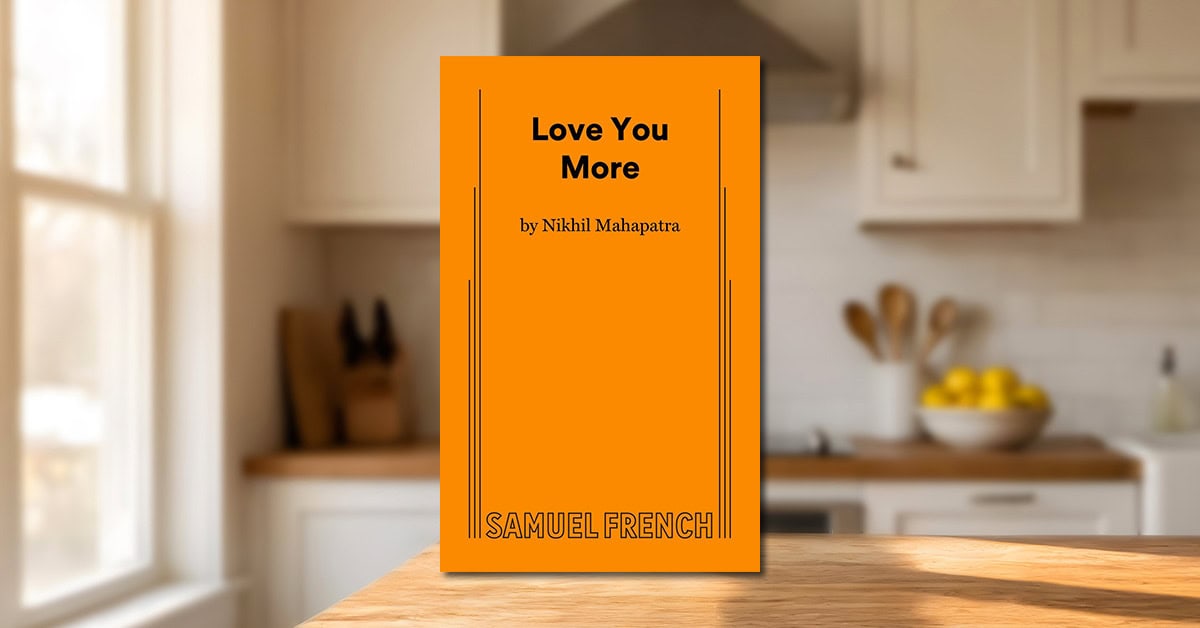
Modern perspectives on grief, aging and returning home collide with a tale of Shakepearean siblings in Nikhil Mahapatra’s moving new work Love You More (US/UK). The play, which premiered at The Tank in New York City in May 2025, reframes the familial (and familiar) saga of King Lear, imbuing it with vibrant characters and fresh takes. Here, Cordelia has just returned from college to a deteriorating Lear and a closed-off, angry Goneril. Lear soon passes away, and Goneril and Cordelia do not know how to continue having a relationship with each other after the only thing connecting them is gone. Love You More is an alternately funny and touching play about three sisters (but actually only two sisters) being sisterly – and figuring out what that means when they’re all that’s left.
We talked to the playwright, Nikhil Mahapatra, to get their insight into the creation process behind this thematically and narratively rich new play.
How would you describe yourself as a playwright?
Rhythmic, tonal and a little shifty.
What was the initial idea that sparked the creation of Love You More?
I wanted to write a prequel to King Lear that centered on Lear’s relationship to his daughters and how he had come to favor one so strongly over the others. While elements of that spark still remain, it turned out to be a very different play in the end!
The role of Lear is often portrayed as a man adrift and uncertain – even untethered to his own time. How did you conceive of your own Lear and the emotional chasms they have with their daughters?
Lear is a heavily flawed character in the original story, and the tragedy of the play is really how he fails on so many accounts to make better choices. I don’t think my modern Lear is quite the same, but I do think there is a relationship [between the two] on the theme of paternal love. When we are young, and if we are lucky, we see our parents as infallible and protective creatures, and as we age, we understand them to be who they are – simply human, simply flawed, often trying their best even if we may feel it fall woefully short. My Lear simply falls short, as they all do.
Gunny/Goneril’s entrance into the play marks a dramatic tonal change in Love You More. What themes did you want to highlight and intensify in the second half of the play?
Goneril’s constant presence, ghostly in the beginning and strongly present in the second half, is an oppositional reflection of Lear’s presence in the play – where Lear starts out fully present, and by the end of the play becomes a sort of ghost. I wanted to highlight how family transitions and relationships change over time, as we occupy and disseminate roles that others held before us. And I also wanted to underline how our relationship with people – whether they are next to us, far away from us, or dead – shape us and continue to shape us for all the time of our lives. I believe we create our own ghosts, and a haunting can be as much a blessing as it can be a curse when visited by those long gone. And Cordelia learns that is very much what Goneril and Lear continue to do, in various capacities.
Food and eating plays a huge role in Love You More, as a way of taking up space, filling silence, dealing with awkward emotions. What role do you see it having in the play?
Food is funny. It’s human. It’s ever-present and tied to so much sense-memory. It can often act as a stand-in for saying or doing something else. Food is real, whereas so much of the set, the characters, the story, are approximations. I feel there are few things that can evoke as much in us as food can. Also, people love seeing food on stage, maybe because they are hungry for dinner after the show or were prohibited from bringing food inside. In the end, we are beasts.
The psychology of sisterhood seems to be an important through-line in Love You More, with characters almost feeling as if they are devolving into their childhood selves in the face of their grief. What drew you to writing about sisterhood?
We are consistently shaped by all the relationships around us, but I do think sibling relationships are a little special. As opposed to parents or friends, your sibling is tied to you in a fight for resources, in a quest for personal authenticity despite shared backgrounds, and in multiple key investments (the home, the family, etc.). This leads to people with incredibly close sibling relationships or those further apart – all valid, all interesting, all messily tied together. Theatre loves tension, and tension is created when two opposing forces are tied together, and nothing is quite like it, like a sibling who keeps stealing all your shit.
“We don’t talk like this, do we?” This quote from Love You More presents a multiplicity of perspectives and recollections. What interested you about directly calling out the fact that events on stage might be influenced by how your characters remembered/envisioned them?
Our memories are intense and false things. When I first started writing for theatre, my form would often be entirely realistic, like a cinematic replay of events. But as I have come to understand the fallibility of human nature, the multiple tricks and truths of the brain, I have come to really enjoy a form that takes all that recollected falseness into account – by presenting story as naturally meta-theatrical, self-reflective and relishing in an unsteady awareness of its own self.
In reading Love You More, I was reminded of plays like Constellations and Arcadia – works that move through time at their own quick velocity and carry the audience with them. How did you conceive of the play’s pacing and structure?
I didn’t really conceive much – the play’s pacing comes from its own internal rhythm, refined through a lot of redrafting and questioning. I usually let impulse guide me through the composition of a new work, for better or worse. Usually, I am also influenced by what I am watching and reading at the time, but I can’t remember what that was now.
If there’s one thing you’d want audiences to take away from your play, what would it be?
The play, in its recollections, scatterings and smatterings of memory and relationship, circles back on itself several times. I offer this to anyone who likes it – our lives also circle back on themselves, constantly. We are constantly rewriting ourselves, and when in draft, there’s always room to tweak things a little here and there, for a kinder version of ourselves and our relationships. Not to say we should ignore our failings while striving to improve, but I don’t believe in consigning ourselves to failure.
To learn more about Nikhil’s work, visit their author page at Concord Theatricals, or discover more about the play in the US or UK.

Listen to the Bees: Kate Douglas Discusses Her Play The Apiary
Playwright Kate Douglas talks about her new dark comedy, an unsettling and sharp-witted cautionary tale about death, the planet, women, power and bees.
Absurdist Theatre: Works That Challenge And Inspire
What does it mean to be alive, day after day and hour after hour? Discover how many of the theatre’s most gifted playwrights have answered this universal question in this collection of moving, challenging, memorable plays affiliated with the Theatre of the Absurd.
Tennessee Williams in Five Plays
Tennessee Williams has a decades-spanning legacy of incredible plays with complex and challenging roles for all actors, but especially leading ladies. Discover more about an American master with this sampling of five plays.