
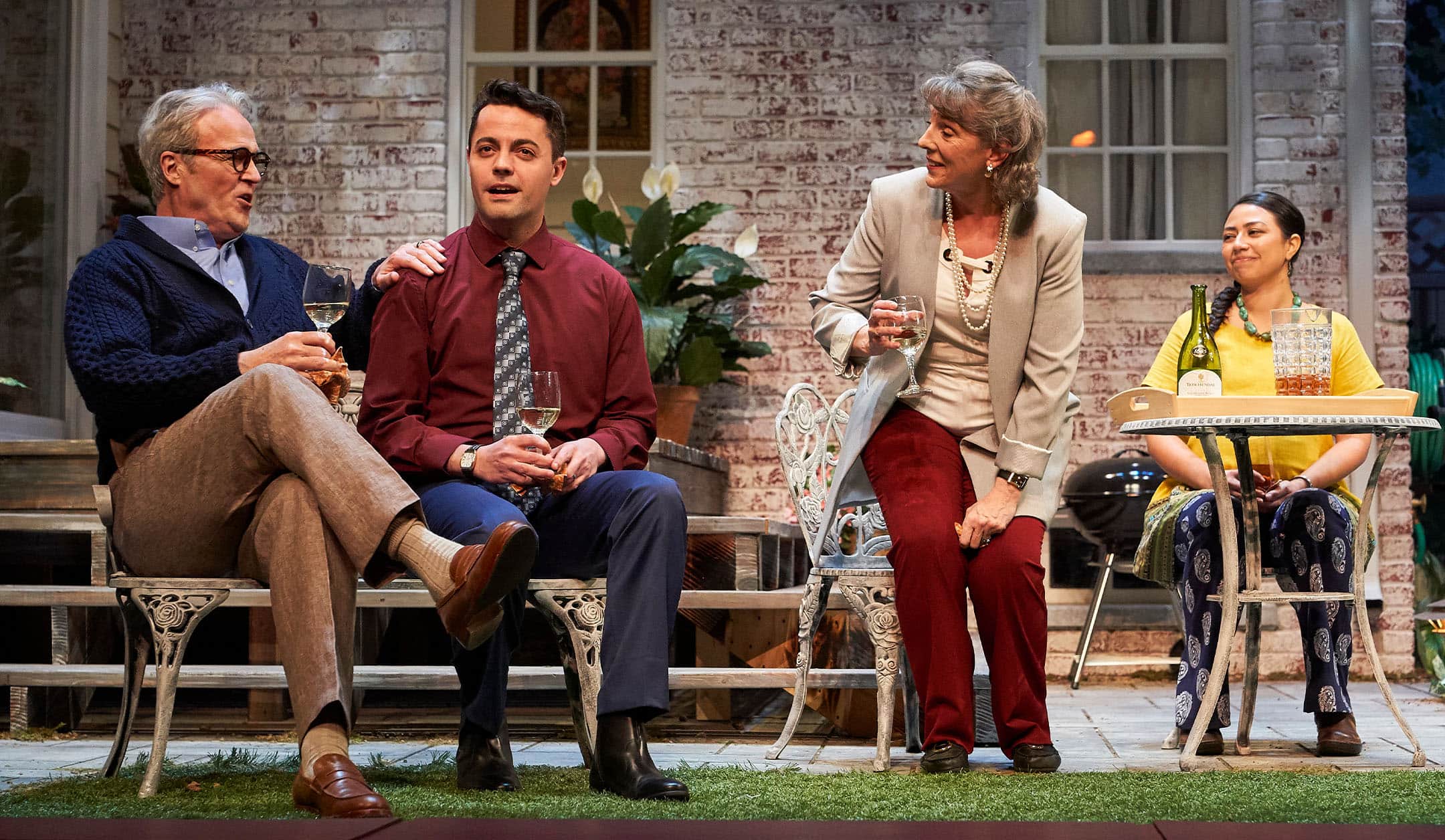
2019 Cleveland Play House production of Native Gardens (Roger Mastroianni)
The road to green-thumbed conflict is paved with good intentions in Karen Zacarías’ sharp satire Native Gardens (US/UK). From identity and culture to the intricacies of landscape surveying, Zacarías’ work deals with difficult questions with warmth and humor. Pablo, a high-powered lawyer, and doctoral candidate Tania, his very pregnant wife, think they are realizing the American Dream when they purchase a house next door to community stalwarts Virginia and Frank. But a disagreement over a long-standing fence line soon spirals into an all-out war of taste, class, privilege and entitlement. Soon, insults fly and laughs abound in a play that speaks to all the repressed feelings of injustice, real or not, that are caused by living in very close proximity to others.
In celebration of the 10th anniversary of its premiere at Cincinnati Playhouse in the Park, we reached out to Karen to talk about her writing and to discuss Native Gardens in fuller detail.
What was the initial idea that sparked the writing of Native Gardens?
I was at a dinner party and the hosts were recounting a battle they were having with their next door neighbors over something small that had exploded into a huge legal and emotional ordeal, which led to several other people regaling us with hilarious and horrible stories about neighbors (people getting stabbed by shears over a shrub issue! Mailboxes moved in the middle of the night, and so on.) It’s terrible to be at war with someone who lives right next to you. I was intrigued by how primal all these fights were and how they involved ideas of property, principles and culture. I thought making a comedy about it could be an interesting study on how we seed conflict and war in our everyday lives.
How would you describe yourself as a playwright?
Joyful and subversive.
Native Gardens is a play whose laughs come in part from its portrayals of the well-meaning liberal suburbanite, such as when Virginia proudly states, “Of course we listen to NPR.” How did you balance creating satirical archetypes that generate comedy with creating characters that feel lived-in and fully dimensional?
The devil is in the details – comedy is usually based on archetypes, but filling in a real backstory, real wants and real pain grounds the characters. My goal was to disarm the audience by laughing and judging the characters, only for them to realize at the end that they are judging themselves.
Native Gardens could also be described as a comedy of passive-aggressiveness. Given that a lot of annoyances and prejudices remain bubbling under the surface for large parts of the play, how did you go about working this into a dialogue-forward art form like theatre?
I think passive-aggressiveness is so delicious on stage because it gives the actors and director great choices about when to be earnest and when to be biting. I love watching the creativity it sparks in other artists.
Much of the conflict in the play is driven by your male characters and their focus on “machista” and “cojones.” Do you see masculinity, and the desire to seem tough, as guilty of exacerbating any disputes (territorial or otherwise) we might have?
In the case of Native Gardens, the men set the battle in motion, but it’s the women who deepen the stakes, so to speak.
The notions of “fake” and “real” diversity, as exemplified by the Butleys’ cultivated, globe-spanning garden vs. the Del Valles’ native biodiversity, are key thematic through-lines in the play. What excited you about exploring the way various groups choose to affirm their claim to diversity?
I think the greatest strength of this country is its diversity, and discussing that is always interesting to me. On the meta side: I loved creating roles for older white actors and younger Latine actors that subverted expectations and the real friendships that have bloomed from these productions. There is a club of many of the actors that played “Tania” where they discuss how playing a pregnant PhD candidate affected them. For many theaters, Native Gardens became one of the first times Latine actors were hired to grace their boards.
Images of the idealized American life play a large part in Native Gardens, from the Del Valles posing in a tableau like Grant Wood’s American Gothic to the play’s setting near D.C., the seat of government. What interests you about subverting aspects of American history and iconography?
As a Mexican, an immigrant and now a US citizen, I feel I have a unique perspective on how “Americanness” feels and looks from the outside to the inside. I do not take anything for granted.
Native Gardens feels undeniably prescient, especially Frank’s line about “considering voting for Obama” and the escalating levels of pettiness and spite. What do you think goes into making satire that feels timeless?
Truth telling. I wrote this play over ten years ago; it premiered at Cincinnati Playhouse in the Park (directed by Blake Robison) in January of 2016, when things were getting heated over Trump and walls. But any immigrant of color will tell you, these feelings have been simmering for decades.
The ending of the play gives us an image of these two warring families coming together in a moment of crisis. How do you conceive of the ending, and did you want to present a sort of model for political and social compromise?
I had a different, very depressing ending in my first draft, but the drama of it left me feeling hollow. We all know how things can get from bad to worse; we see it in the news all the time. I asked myself, “What does it take to make things, not great, but better?” The answer is surprisingly simple and rooted in humanity.
If there’s one thing you’d want audiences to take away from your play, what would it be?
From what people tell me, audiences spend a lot of the play judging the characters but leave judging themselves. I have gotten so many letters from people who said memories of the play helped them find ways to de-escalate an issue with their neighbor. I also know many people have learned about “native gardening” (including me!) and now incorporate it into their lives. I am so grateful for how a small four-hander comedy has taught me so much and continues to bloom.
To license a production of Native Gardens or purchase the script, visit Concord Theatricals in the US or UK.
Women in STEM: Characters Across Science, Technology, Engineering and Math
While historically underrepresented, dozens of women across both history – and fiction! – excel in the fields of science, technology, engineering and mathematics (STEM). Here, discover brilliant theatrical works that feature these ladies.

Ian McWethy in Five Plays
Discover five hilarious, charming, inclusive plays by Ian McWethy, a playwright loved by audiences of all ages.
Community Theatre: Your 2026 Guide to Season Planning
Need help planning your next community theatre season? This selection of celebrated and noteworthy Concord Theatricals titles – arranged by genre – is sure to include the perfect show for your theatre and your audience.