
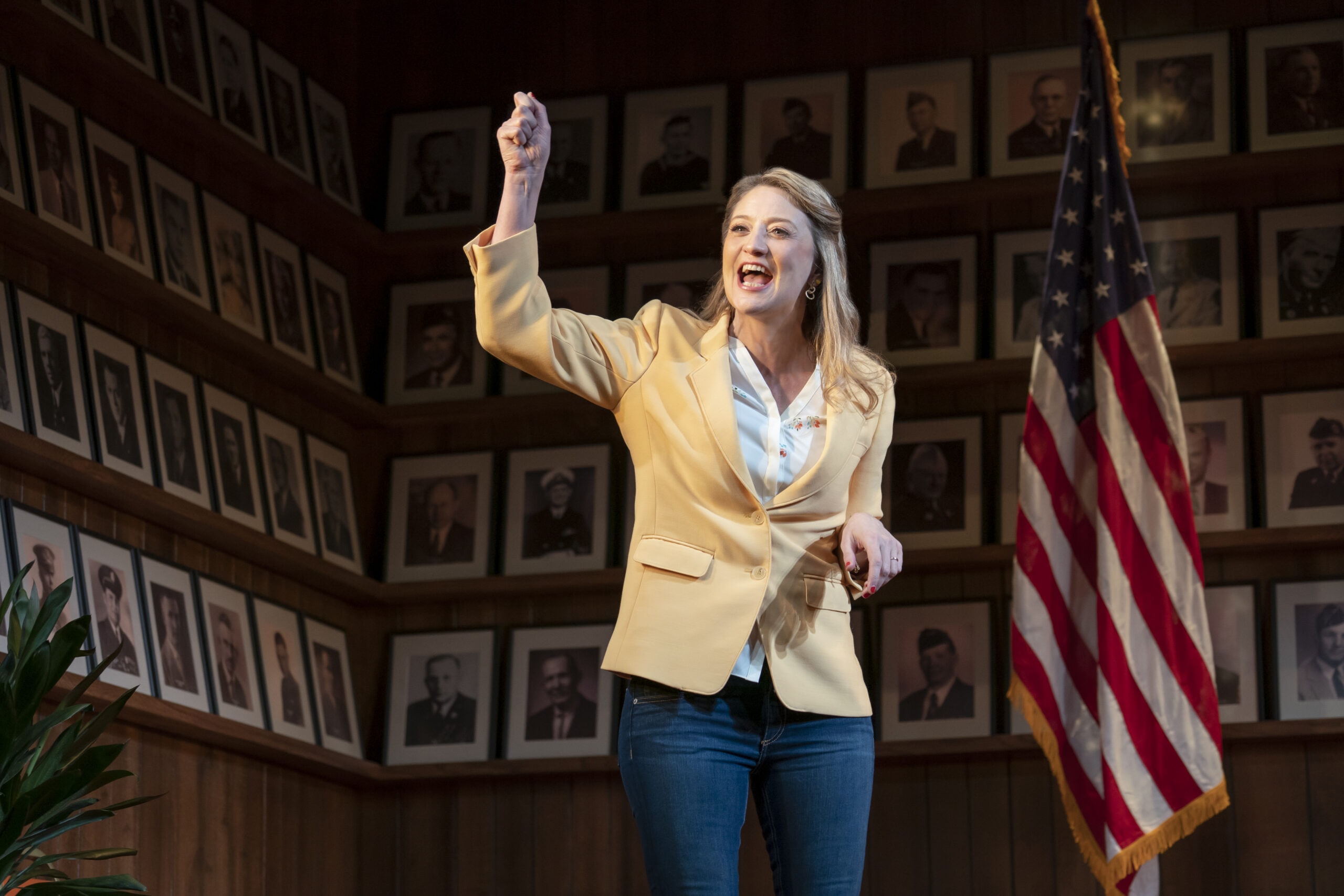
2019 Broadway production of What the Constitution Means to Me (Joan Marcus)
In this edition of the “In Conversation With…” series, Breaking Character presents a sampling of shows that speak to the many animating forces behind politics: lust for power, a strong sense of justice, a desire to enact meaningful change. Whether exploring the titanic (and stubborn, or cruel, or complex) figures at the center of politics, the lobbyists who have an outsize influence on political movements, or the consequences of electoral rhetoric, these shows are all fascinated with dynamics of power and who gets to wield it. Thrilling and powerfully-crafted, these shows make politics a spectacle that demands attention.
53% Of by Steph Del Rosso (US/UK)
(Full-Length Play, Dark Comedy / 6w)
The play: The President is coming to town, and the ladies of Bethlehem, Pennsylvania are beside themselves planning for the big event. Later, their husbands drink beer and talk smack. Much later, a group of 20-somethings gather in Brooklyn to plan a fundraiser… or is it a march? Or is it a ritual to absolve their own guilt? A play about complicity and the violence of the status quo, 53% Of asks what happens when we stop equating white womanhood with goodness and ignorance with innocence.
On Politics: No one escapes judgment in Steph Del Rosso’s lacerating examination of one of the most shocking statistics in recent American politics. Set in the heart of the battleground state of Pennsylvania, 53% Of explores the dimensions of white privilege and its insulating effects. Focusing in on the individuals whose votes formed part of one of the most radical political changes in recent American history, 53% Of looks at how easy it is to view politics in the abstract until its consequences become all too real.
All the Way by Robert Schenkkan (US)
(Full-Length Play, Drama / 3w, 17m)
The play: November, 1963. An assassin’s bullet catapults Lyndon Baines Johnson into the presidency. A Shakespearean figure of towering ambition and appetite, this charismatic, conflicted Texan hurls himself into the passage of the Civil Rights Act – a tinderbox issue emblematic of a divided America – even as he campaigns for re-election in his own right, and the recognition he so desperately wants.
On Politics: An in-depth, deeply-researched, yet undeniably thrilling portrait of a titanic figure in American politics, All the Way takes on everything from generation-defining laws to the minutiae of political debate. With the meaty role (which won Bryan Cranston his first Tony) of Lyndon Baines Johnson at its centre, All the Way is about how history is shaped. Through force of personality and force of government, great movements can be achieved. All the Way is a consequential drama for a consequential President.
Archduke by Rajiv Joseph (US/UK)
(Full-Length Play, Dark Comedy / 1w, 4m)
The play: Belgrade, 1914. Three hungry young men are offered something to eat (and the chance to change the course of history). Their mission: kill Archduke Franz Ferdinand and set the century alight. Embark on this darkly comedic journey by award-winning writer Rajiv Joseph – described by Time Out as “a delicious cackle in the dark”– as it uses history (and comedy!) to talk about the past in tandem with our own moment.
On Politics: Plays set in the past – especially a century earlier, as in this instance – often provide the most thoughtful and effective critics of contemporary politics as the distance setting provides ample emotional distance for audiences to examine parallels to the present with specific historical events, and the infusion of comedy causes audiences to first laugh, then ask themselves why they are laughing. In this sharp, funny and dangerous timely play, Rajiv Joseph blends biting wit with mounting tension to examine yes, the historical moment of the assassination that started World War I, but also masculinity and the absurdity of modern terrorism.
August Wilson’s Radio Golf by August Wilson (US/UK)
(Full-Length Play, Dramatic Comedy / 1w, 4m)
The play: August Wilson’s Radio Golf is a fast-paced, dynamic and wonderfully funny work about the world today and the dreams we have for the future. Set in Pittsburgh in the late 1990s, it’s the story of a successful entrepreneur who aspires to become the city’s first Black mayor. But when the past begins to catch up with him, secrets get revealed that could be his undoing.
On Politics: Part of August Wilson’s century-spanning tribute to the Black American experience known as The Pittsburgh Cycle, Radio Golf (the last to be premiered and set the latest in time) explores how politics intersects with issues of gentrification and community. As the economic boom of the 90s opened up new possibilities for those with the capital to take advantage, many historically-minority neighborhoods found themselves radically changed. Radio Golf uses Wilson’s beloved Hill District to delve into politics on the local level.
Autumn by Richard Wesley (US)
(Full-Length Play, Dramatic Comedy / 3w, 4m)
The play: Franklyn Longley is a veteran big-city mayor who’s in line to become the first Black governor of his state – until his godson is tapped by the party to run instead. As a new generation of Black politicians comes forward, they must learn there is a price to pay in order to realize their ambitions. This gripping political drama explores the conflicts that arise when aspirations collide across generational, racial and gender divides.
On Politics: This play focuses on the way politics is played among Black communities – strongholds of the Democratic Party whose voices are often simplified to one sentiment. In Richard Wesley’s incisive, well-drawn Autumn, the simple fact that only one person can win a race (and benefit from the accompanying power and prestige) causes long-held alliances to shift and political conflicts to be fought on new terrain. Institutional power looms in the background of many primary races, and Autumn explores by which metrics that power is doled out.
Dakar 2000 by Rajiv Joseph (US/UK)
(Full-Length Play, Drama / 1w, 1m)
The play: Boubs is serving as a Peace Corps volunteer in Senegal and is a little fed up with all the red tape. The morning after he crashes a supply truck that he has filled with misappropriated goods to aid a local village’s gardening group, he is reprimanded by Dina, the seasoned U.S. security agent now in charge in Dakar. She presents the smooth talker with an ultimatum: a one-way ticket back to the States or a make-good mission. Smitten with Dina and desperate to make an impact, Boubs jumps at the chance to redeem himself.
On Politics: A look at American soft power as seen through the eyes of the world, Dakar 2000 engages meaningfully with questions of loyalty, love and morality. Rather than examining world events through a solely American lens, Rajiv Joseph’s insightful work traces the ripples that the American political complex can have for the Global Majority. Set at the dawn of the new millennium, when questions of globalization were growing increasingly relevant, Dakar 2000 engages with politics now, through the functionaries that accomplish it and the citizens who may end up being collateral.
Evita by Tim Rice and Andrew Lloyd Webber (US)
(Full-Length Musical, Drama / 2w, 3m + ensemble)
The play: Evita charts the young and ambitious Eva Perón’s meteoric rise to sainthood. Set in Argentina between 1934 and 1952, the Tony-winning musical follows Eva Duarte on her journey from poor illegitimate child to ambitious actress to – as wife of military leader-turned-president Juan Perón – the most powerful woman in Latin America, before her death from cancer at age 33.
On Politics: Again moving the political lens towards the global, Evita has a majesty and grandeur worthy of the individual at its center. One of the most-awarded musicals in history, Evita takes the political biopic (or bio-musical) and expands its boundaries. Through Broadway classics like “Don’t Cry For Me, Argentina” and “High Flying, Adored,” the show explores the seductions of money, fame and power. Politicians tend to be seen as distant figures, but Evita’s brilliance lies in how it renders the leaders of a nation incredibly intimate.
Heroes of the Fourth Turning by Will Arbery (US/UK)
(Full-Length Play, Drama / 3w, 2m)
The play: It’s nearing midnight in Wyoming, where four young conservatives have gathered at a backyard after-party. They’ve returned home to toast their mentor Gina, newly inducted as president of a tiny Catholic college. But as their reunion spirals into spiritual chaos and clashing generational politics, it becomes less a celebration than a vicious fight to be understood.
On Politics: Speaking directly to the political landscape of America today, Will Arbery’s Heroes of the Fourth Turning does not shy away from thorny social subjects. Sharply questioning how Christian conservatism became so formative for a large subset of young Americans, the play treats characters with empathy and grace. This is not a diatribe against any given ideology. Rather, Heroes of the Fourth Turning is an effort to dig into how American politics became so fractured. In turn, it explores generational change and psychological unraveling through its young, complex characters.
Hillary and Clinton by Lucas Hnath (US)
(Full-Length Play, Drama / 1w, 3m)
The play: In an alternate universe light-years away from our own is a planet called Earth. It looks a lot like our Earth, except it’s slightly different. And living on this other Earth is a woman named Hillary. Hillary is trying to become the president of a country called the United States of America. It’s 2008, and she’s campaigning in a state called New Hampshire. You may think you know where this story is going, but you don’t.
On Politics: To quote the playwright himself: “I’ve always been interested in people whose image has been simplified or oversimplified. I’ve always been curious to see what happens if you take that person and create a few small tensions with the image.” Lucas Hnath’s incisive play takes an incredibly familiar political story and examines it from all angles. Is what we know (or have heard reported) ever really the truth? Can singular figures in American history be fully reconstructed, or will we ever only know facets of their personalities? These are people whose reputations precede them – the gambit of Hillary and Clinton is that theatre still has the scope to explore these reputations on the stage.
Kings by Sarah Burgess (US)
(Full-Length Play, Drama / 3w, 1m)
The play: Kate is a sharp-witted lobbyist who doesn’t waste her time on candidates who can’t get elected, stay elected, and, above all, remain loyal to her clientele. Representative Sydney Millsap has a more idealistic approach to politics, which Kate fears may cost Millsap a prosperous political career. But when Millsap’s high-minded principles prove surprisingly resilient in Washington, Kate faces an unexpected dilemma: back the system or back what she actually believes in.
On Politics: Lobbying has a dirty reputation among all parts of the American political spectrum. It conjures up images of backroom dealings and promises broken. But by delving into the psychology of one increasingly-conflicted lobbyist, Sarah Burgess’ sharp, thrilling Kings moves beyond stereotype and presents a multifaceted look into what actually gets policy passed. As questions of authenticity and idealism become even more hotly-debated on the political stage, Kings speaks forcefully to a question both topical and timeless: what does it take to win a race?
Labour of Love by James Graham (US/UK)
(Full-Length Play, Comedy / 3w, 3m)
The play: MP David Lyons parachuted into Parliament with Tony Blair’s generation of center-left politicos focused on electability and effectiveness. His local office director, Jean Whittaker, firmly believes in the pro-union, far-left policies that have historically served his constituency deep in the heart of British coal country… a district that in 2018 just might turn conservative for the first time in a century. Unfolding over decades, across multiple election nights, through economic booms and busts, this wickedly funny clash of values and class reflects the shifting British political landscape.
On Politics: Politics takes a hop across the pond in Labour of Love, which explores the social dynamics that have animated the last few decades of the British left. New Labour vs. Old Labour. Trade unions vs. civil servants. Local knowledge vs. national campaigns. The story of Labour’s rise and fall in Northern England’s industrial heartlands is just as dynamic and full of shifts in public opinion as its American equivalent, and Olivier Award-winning playwright James Graham brings it to life masterfully. Here, radicalism can only go so far as they voters will take it.
N/A by Mario Correa (US/UK)
(Full-Length Play, Dramatic Comedy / 2w)
The play: N is the long-serving House Democratic Leader – the embodiment of the political establishment. A is the unwelcome insurgent – the young firebrand who has just unseated N’s heir-apparent. Now each woman must enlist the other in her quest to fulfill her own vision for the country in this battle of wills and wits between the old guard and the new.
On Politics: The last decade of American politics (on the left) has been marked by clashes between idealists and pragmatists, progressives and centrists, firebrands and deal-makers. Mario Correa’s N/A brings these philosophical and theoretical debates to the stage through two powerful, strong women who may very much resemble two towering figures in the Democratic Party. N/A asks what the path forward is for a party whose recent history is defined as much by the times it fell short as for the times it succeeded.
POTUS by Selina Fillinger (US/UK)
(Full-Length Play, Comedy / 7w)
The play: One four-letter word is about to rock 1600 Pennsylvania Avenue. When the President unwittingly spins a PR nightmare into a global crisis, the seven brilliant and beleaguered women he relies upon most risk life, liberty and the pursuit of sanity to keep the commander-in-chief out of trouble.
On Politics: POTUS, or to give it its full title, POTUS or, Behind Every Great Dumbass Are Seven Women Trying to Keep Him Alive, is a farcical, fast-paced ride that defines its unseen male political figure by the various women integral to keeping his image, moods and way of life modulated. Exploring the chaos of the most most important office in the world with humor and charm, Selina Fillinger’s work is a celebration of the female experience, even as it often get relegated to the shadows.
Strike Up the Band by George Gershwin, Ira Gershwin and George S. Kaufman (US/UK)
(Full-Length Musical, Political Satire / 3w, 7m + ensemble)
The play: Horace J. Fletcher, proud owner of the Fletcher American Cheese Co., is outraged when Switzerland protests a tariff on imported cheese and convinces the U.S. government to declare a war. He offers to finance the war personally – as long as the war is named after him: “The Horace J. Fletcher Memorial War.” “What did the government make out of the last one, handling it themselves? Nothing!”
On Politics: With some of the Gershwins’ most famous tunes (including the rousing title song and “I’ve Got a Crush on You”) in tow, Strike Up the Band is a shockingly-prescient, laugh-out-loud satire of politics, capital and war as an enrichment device. From Connecticut to Switzerland, the Gershwins and collaborator George S. Kaufman suggest that the only thing that makes people happier than war is money, while the only surefire way to generate money is war. A biting satire, Strike Up The Band’s cynical view of politics and the people who inhabit its world remains viciously funny and regrettably timeless.
The City of Conversation by Anthony Giardina (US/UK)
(Full-Length Play, Drama / 4w, 4m, 1 boy)
The play: In 1979, Washington D.C. was a place where people actually talked to each other… where adversaries fought it out on the Senate floor and then smoothed it out over drinks and hors d’oeuvres. But it was all about to change. In this play spanning 30 years and six presidential administrations, Hester Ferris throws Georgetown dinner parties that can change the course of Washington’s politics.
On Politics: A look at the dinner-party circuit where the bulk of the fabled “reaching across the aisle” used to happen, Anthony Giardina’s play gives just as much weight to the art of the conversation as it does to oration. Here, socialite Hester Ferris influences policy in D.C. through one of the few options women of that era possessed: bringing various people of importance to their home for dinner. Yet, as the play charts the rise of partisan politics, it asks: have we lost the ability to talk but not yell, to suggest but not hector, to compromise but not cave?
The Democracy Project by Tanya Barfield, Lisa D’Amour, Larissa Fasthorse, Michael R. Jackson, Melissa James Gibson and Bruce Norris (US/UK)
(Full-Length Play, Drama / 2w, 3m, 2 any gender)
The play: This dynamic, provocative play – co-created by six celebrated theatre makers to honor Federal Hall in New York City – asks big questions about America’s land, its inhabitants and ownership. This is a perspective-shifting odyssey through the 527 days when Federal Hall was the nation’s first capitol; when the presidency was new, the slave trade was in debate, and the Constitution – and the rights of all this land’s inhabitants – hung in the balance. Democracy is like theatre: Sometimes the collaboration is smooth, sometimes messy, sometimes hilarious, sometimes unnerving – but you’ll get a show nonetheless.
On Politics: The play was commissioned by the Federal Hall Conservancy, whose goal was to bring back the importance of Federal Hall, now a national memorial, as a forum for public discourse by presenting a play based on its storied history, free to the public. The project came together organically. It was playwright Bruce Norris who suggested we invite several different playwrights to imagine what a fresh telling of our history could look like. This was a few months after the tumultuous presidential election of 2016, and many were looking to history to give context the moment.
The Election by Don Zolidis (US)
(Full-Length Play, Comedy / 2w, 3m, 19 any gender youth)
The play: After an embattled student body president resigns in disgrace, Mark Davenport figures he will cruise to victory in the special election. After all, his only opponent is nerdy Christy Martin, who wants to eliminate football. But when a mysterious Super PAC gives her an unlimited budget, things start to get very ugly in this hilarious satire of contemporary politics designed for younger performers.
On Politics: What if the elections for student government were taken really seriously? No, like really, really, super seriously. That question forms the basis for fast-paced and supremely goofy farce in another fantastic choice for student groups from Don Zolidis. Everything (even balloting) takes on outsize importance to teenagers, and The Election lovingly skewers both high-school and political dynamics to great effect. Even as it renders the political process ridiculous, The Election is still underpinned by a belief that some things are worth fighting for. As such, it allows younger performers to gain an insight into democratic systems that they will participate in (and even be frustrated by) for the rest of their lives.
What the Constitution Means to Me by Heidi Schreck (US/UK)
(Full-Length Play, Dramatic Comedy / 1w, 1m, 1 girl)
The play: Fifteen-year-old Heidi earned her college tuition by winning Constitutional debate competitions across the United States. In this hilarious, hopeful and achingly human play, she resurrects her teenage self in order to trace the profound relationship between four generations of women and the founding document that shaped their lives. How will the next generation of Americans be shaped?
On Politics: A tour-de-force journey through American history, What the Constitution Means to Me melds the presentational and the dramatic. Shifting seamlessly through various ages and tones, Heidi Schreck’s work casts an eye over the patriarchal history of America and asks its audiences how we can transform it moving forward. Centering strong female voices and imbuing a dry subject with vivid theatrical life, What the Constitution Means to Me uses the story of one individual to examine the struggle for equality at-large. A brighter American future can be created through voices like these.
For more incisive and thrilling plays, visit Concord Theatricals in the US or UK.
College Theatre: Consider These Plays & Musicals, Fall 2026
Choose your next show from this wide selection of plays and musicals for colleges and universities, including incisive political dramas, charming rom coms and cutting-edge musicals.

Jen Silverman in Five Plays
Explore award-winning playwright, novelist and screenwriter Jen Silverman’s range of writing through a selection of five of their plays below, each of which bring an interesting yet complex character, bold comedy or poignant theme to life.
Community Theatre: Consider These Plays & Musicals, Fall 2026
Here’s a smart sampling of plays and musicals ranging from long-standing classics to cutting-edge new works, all geared towards a community theatre audience.