
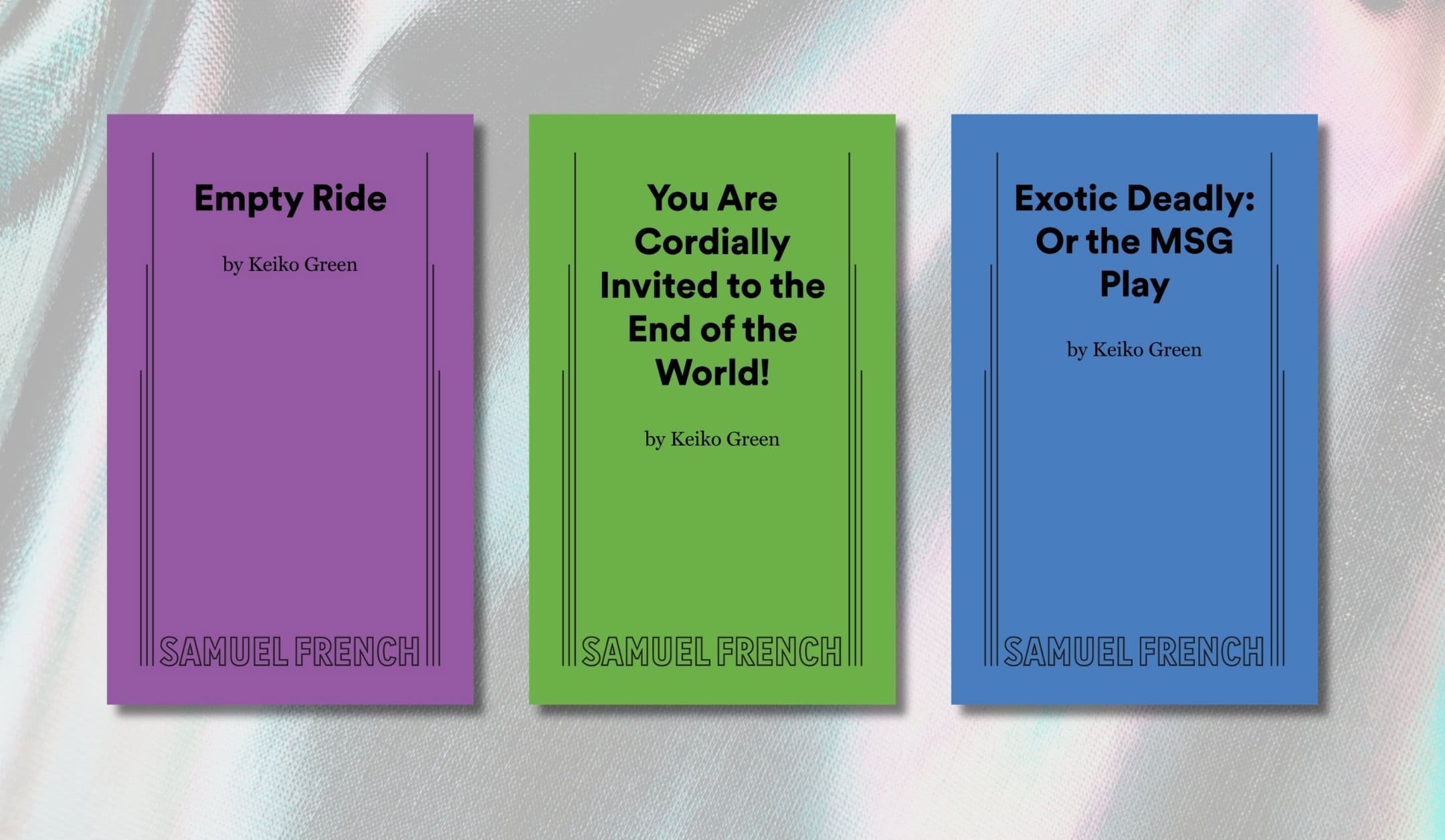
Keiko Green (US/UK) is an award-winning playwright, screenwriter and performer whose blend of humor and heart makes her work both resonant and popular. Her work for the screen can be witnessed in the Emmy Award-winning series Margot’s Got Money Troubles starring Elle Fanning, and three of her theatrical works – including Empty Ride (US/UK), Exotic Deadly: Or the MSG Play (US/UK) and You Are Cordially Invited to the End of the World! (US/UK) – are available to read and/or license from Concord Theatricals.
In each endeavor, her work lies at the intersection of funny and thoughtful, using whip-smart comedy alongside reflective moments to acknowledge the full extent of the human experience, from the awkward to the bittersweet to the hilarious to the somber. It is this combination of skills, paired with keen insights about actor and audience experience, that has led her plays to be produced all across the country. These plays have also earned dozens of accolades (and counting!), from multiple selections by prestigious new work festivals like the Eugene O’Neill’s National Playwrights Conference and South Coast Rep’s Pacific Playwrights Festival, to multiple Outstanding New Play awards and a finalist designation for the Susan Smith Blackburn Prize.
Drawing from her experience as a performer, Keiko crafts stories where theatricality is not just present but utilized creatively – whether it be in anime-inspired stage combat sequences allowing actors to put their movement abilities to the test, unique and inclusive characters that let a range of actors bring comedy to life, or through collaborative design, such as the chance bring a ghost town or an extinct animal support group to life.
In the article below, explore three plays that embody the spectrum of her comedy – in the words of playwright Keiko Green herself!
Keiko! I’ve been quite the fan of your plays since I came across them in my experience as a freelance dramaturg and literary manager. My experience of your shows has always been that they are a balance of comedy and care. In your own words, how would you describe your work/writing overall?
Keiko Green (KG): Put simply, I write character and relationship driven-plays that are front-footed and wildly theatrical. Even when I try to write serious plays, they always end up kind of funny.
I’m so excited to introduce more of the world to your shows through licensing. The first of these three plays, Empty Ride (US/UK), takes place in a coastal Japanese town called Ishinomaki that was left devastated by a tsunami whose remaining areas are being poached by real estate businesses. It’s full of fascinating, well-drawn characters who feel full of life while still figuring things out, which is immensely relatable. Could you talk more about what drew you to write about this small town in particular?
KG: My Obāchan (or Japanese Grandma) lived in Sendai when the tsunami hit in 2011. Sendai was inland of Ishinomaki, but they’re all part of the same region. She was in her 80s and living on her own, but the community made sure she had water, food and other necessities. Just a few years later, I was amazed to see how quickly some communities had bounced back, while others felt like they lost their sparkle for good. That’s when I started reading about Ishinomaki and how every single taxi driver there had reported having a spirit passenger. It made me think a lot about survivor’s guilt and how we can responsibly build back stronger without losing the heart of what it once was.
In Empty Ride, you thoughtfully knit together the story of a Japanese painter returning to her hometown to take over driving her dad’s taxi cab and the supernatural ghosts of those left behind after a tsunami, looking for a ride back to a place that no longer exists. Its use of the supernatural feels focused on grief, longing and memory instead of horror, which we usually associate with ghosts. What did you want to contribute to theatrical ghost stories with this show, and how did you approach the play’s relationship to the supernatural?
KG: When I first started writing Empty Ride, all I knew was that it would involve a taxi driver and a ghost story. There’s actually a section in which a supporting character just stands on stage and tells a really long ghost story. I didn’t know if that would ultimately make it to the stage, but in the first ever public reading at the Old Globe, I remember thinking: “You could hear a pin drop.” The whole audience was leaning forward with bated breath. Sometimes we forget that theatre is ultimately just storytelling. We can put all these bells and whistles onstage, but it felt like the boldest thing I could do was just get out of the way. But we mostly use ghosts in an almost romantic way. Because the jumping off point was based on some real stories of loss in Ishinomaki, it always felt important to bring humanity to those supernatural beings.
Another of your plays, Exotic Deadly: Or the MSG Play (US/UK), brings together a teenage coming-of-age story with the speculation and misinformation around the spice MSG in the 1990s. What was your process for discovering this play and the impetus for writing it specifically?
KG: Exotic Deadly became my first “big” play, and I wrote it at the height of COVID, when we all thought theatre might be dead. It changed my whole way of working because I stopped thinking about what I thought theatres wanted to produce and instead started writing what I wanted to see onstage. I was grieving some big losses in our family, and to escape, I would sit myself in front of my laptop and try to make myself laugh.
In Exotic Deadly, you combat stereotypes about Asian food by making MSG – a sodium often used as a savory flavor enhancer that became vilified by misinformation – a fully-realized character in the show named “Exotic Deadly,” outfitted with a leather jacket, big hair and smoke whose personality is said to “compliment and enhance with incredible depth.” I’d love to know how this depiction came to you and developed into the version in this play!
KG: I first started as an actor, and especially in my early career as an Asian American woman, I was stuck playing extremely sexualized roles: strippers, prostitutes and generally promiscuous women. And it started to piss me off. My mom used to tell me I was like those Japanese candies that were sweet on the inside and spiky on the outside. I always wanted to write an Asian character that encapsulated that rage. And I knew I wanted the play to be extremely theatrical, which meant that I didn’t want to just talk about MSG. I wanted to visually and aurally depict how it tastes, how it can feel. All of those ideas were circulating in my head when I read an article that casually mentioned MSG and the dangers of Asian food with the words “Exotic Deadly,” and those two ideas smashed into each other to become one character that is completely unpredictable and shakes up Ami’s world.
Moving your more bittersweet comedy, You Are Cordially Invited to the End of the World! (US/UK) is a play I got to see an earlier version of at Amphibian Stage’s SparkFest. As someone who had recently lost a loved one to cancer, I was so impressed by how this story talks about different kinds of grief – end of life, climate, etc. – in ways that also care for those in the audience who relate to it. For me, a lot of that has to do with the humor you have infused in the show. I especially loved the invention of a support group for extinct animals and the use of Greta Thunberg as a psychopomp, which creates opportunity for both visual and verbal jokes. What inspired this moment and your use of humor throughout this story?
KG: Both of my in-laws passed away during lockdown in 2020. I remember an especially hard day, when my husband MJ and I were visiting my brother-in-law’s family, and MJ picked up our little baby nephew, who immediately peed all over him… and in the middle of all this grief and sadness, we all broke down in laughter. That’s the tone of the play.
I knew that this play about dying needed to feel alive. That no one should actually feel more alive than our character who receives this terminal diagnosis. I think only through finding humor and joy throughout this play are we able to emotionally take hands and step into exploring some really heavy themes and ideas.
I wasn’t sure if Greta would continue to be a character in the play or not, I wrote her in as an experiment – Who is the perfect person to activate Greg and give him purpose? Who is an inspiring person he could see on TV that could infiltrate his psyche? And she became a mash-up of the real Greta, Peter Pan and a guide into the afterlife.
Exotic Deadly and Cordially both offer great chances for physicality – the first with anime-inspired combat sequences, the latter with a narrative framing device of theatrical spectacle and the joy of dance. I love this invitation for collaboration for actors and movement professionals. What is your hope for future productions of these shows with these opportunities for movement in mind?
KG: I love fights. I love a musical number. I love choreographed dance. Even the episodes of TV I write often have a dance sequence… I’m a Drama Kid, what can I say? I hope that physical sequences feel fun and unique to the specific company that came together to put together this production. They should walk away from rehearsal laughing, “Only we would have thought of this!” I also have an allergy to being “too cool.” Musical numbers should feel inclusive and perhaps a little dorky! It should be about inviting people into our world, not showing them how cool we are.
Now that they’re available for licensing from schools to community theatres to professional theatres, what do you hope to see in future productions of your plays?
KG: Most of my plays ask for a lot from the cast and crew. I think I write actor-driven plays, but they are often described as “a designer’s dream,” so hopefully it’s both? There are often a few characters playing a million roles. Time and location keep shifting around our characters. I’ve already gotten to see some versions of how creative minds can take on these challenges, but there are so many possibilities! If productions can insert their own personalities in there, all while hitting all those important emotional beats, that would be my heaven.
On a parting note, what is the one thing you hope audiences/theatres take away from seeing or producing one of your plays?
KG: I hope that audiences go back into the world feeling alive! My plays often deal with legacy and family and finding purpose, all while cracking you up. I hope that audiences laugh so hard their stomachs hurt, but also that they take home some big questions to mull over… and ultimately see the life around them in brighter colors.
To learn more about these plays by Keiko Green and purchase a script or license for one (or more!), visit Concord Theatricals in the US or UK.
Shows for Every Audience
Warm and inviting, these shows are an accessible way to experience the magic of live theatre. For any age and any background, they’re sure to delight audiences and give actors a chance to shine.

Thank You, Teachers
To honor the wonderful educators who motivate young theatre artists, Concord Theatricals authors thank their most inspiring teachers.
College Theatre: Consider These Plays & Musicals, Fall 2026
Choose your next show from this wide selection of plays and musicals for colleges and universities, including incisive political dramas, charming rom coms and cutting-edge musicals.