
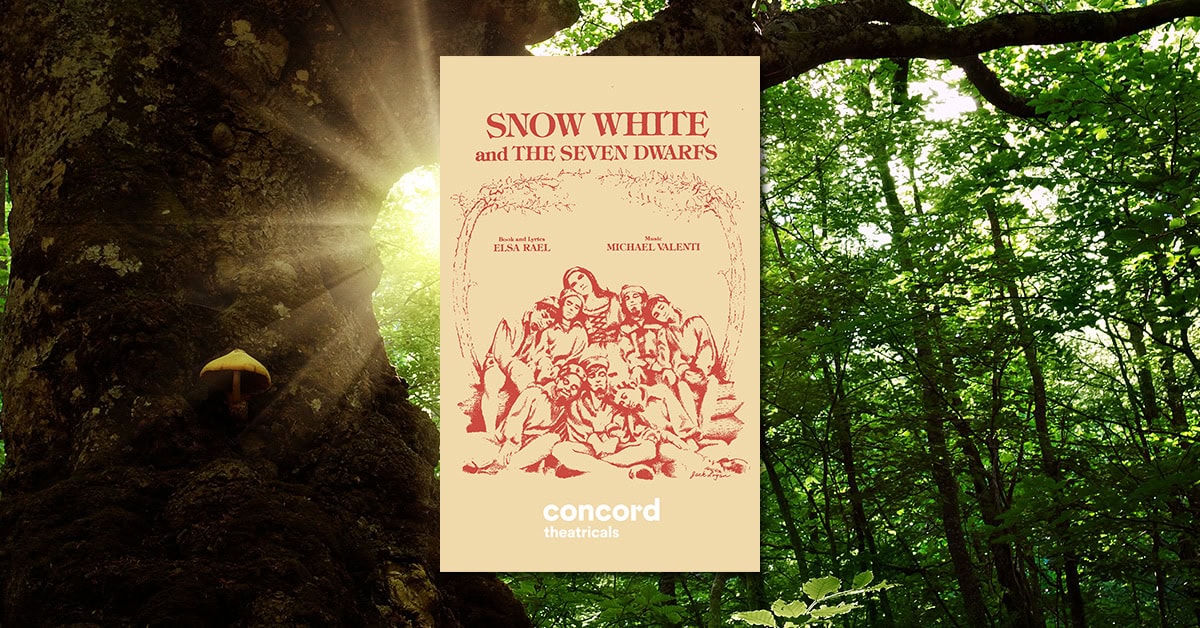
A festive favorite, Elsa Rael and Michael Valenti’s charming musical adaptation of the classic fairy tale has entranced audiences since its debut performance on December 18, 1965. Full of beautiful songs, family-friendly drama and magical moments, Snow White and the Seven Dwarfs (US/UK) has a decades-long legacy of good-natured fun and cheer. In light of the show’s 60th anniversary, we reached out to composer Michael Valenti to hear – in his own words – the stories behind the musical that would become the longest continuously running children’s show ever produced on or off-Broadway.
On meeting The Gingerbread Players and Jack (the company that produced the debut performance of Snow White and the Seven Dwarfs):
One night when I arrived home after a performance of How to Succeed [Valenti was part of the original Broadway cast of How to Succeed in Business Without Really Trying], I happened to notice that lights were on in the little theatre across the street from my apartment building. The door to the basement was open, so I walked down the steps and invited myself in. Standing in the back, I could see a small stage surrounded by 131 seats on three sides. The back of the stage was the back wall of the basement, and if you lifted your arms, you could almost touch the ceiling. I was soon to find out that Jack Logan, a successful children’s illustrator, was the designer of this magical place. I was standing in the back admiring the scenery when a man rushed out of one of the two dressing rooms carrying a bundle of costumes.
“I hope I’m not interrupting you,” I exclaimed.
“You’re not bothering me at all. I’m just trying to straighten up and get ready for tomorrow’s shows.”
He dropped the costumes on a seat in the first row, went backstage and returned with an iron and ironing board. He told me his name was John Ahearn and said that he and his partner Guy Grasso were the producers of a children’s theater company currently occupying the theater. They called themselves “The Gingerbread Players and Jack,” and the show they were performing at the moment was Pinocchio and that he and Guy were actors in the company as well. He said that “The Gingerbread Players” was an Equity repertory company that performed on weekends and that all the scripts and scores were original. He told me the orchestra consisted of a solo piano and pointed to an old upright nestled under the stairs behind a row of seats. I told him my name and suggested that, since he used original music, I would like the opportunity to submit some of my work.
On his first collaboration with the group:
After the performance [of Pinocchio], I went backstage and met the cast. When I met Guy Grasso, he said that John had told him that I was interested in composing some music for the company. Guy went on to say that in the spring he would be making his directing debut with a new production based on the story of Midas, the king with the golden touch. He then asked me if I would be willing to write a couple of songs on spec. I told him that I’d be delighted to. He handed me a script, and I went home excited and anxious to read it. Eventually, I composed two songs I was rather proud of: the opening “Today’s the Day” and a ballad entitled “A Special Man.” I liked the second song enough to include it years later on my album Music in Search of a Musical.
On a career revelation:
By the spring of 1965, How to Succeed in Business Without Really Trying was finally beginning to slow down. Feuer and Martin decided to send the Broadway company out on the road after it closed in New York, and I decided to go with it. One night, when I was lying in bed, I had a revelation and called out to my mother, who was in the next room.
“Mom, I don’t think I want to be an actor,” I said.
“What?” She asked, in a shocked voice, having attended that night’s performance.
“I don’t want to be an actor. I want to write music.”
On the genesis of Snow White:
I had been planning to ask John and Guy if they had any ideas. I locked my motorcycle and walked across the street.
“I was just going to call you,” John said as I entered the theatre.
“We’re getting ready for our Christmas show, which will be a new production of Snow White and the Seven Dwarfs, and we need a new score. I directed it a couple of years ago and although I liked the book and lyrics, I didn’t like the music. Would you be interested?”
I told him how funny I thought it was that he would be asking me to write something at this time, since I was about to ask if he or Guy had any new projects that needed music! I also told him that I’d welcome the opportunity to write with a lyricist.
A few days later, John set up a meeting for playwright/lyricist Elsa Rael and me to meet. I liked her immediately, and we both felt we would have no problem working together. I had read the script, and I found her book moving and well-constructed. Her lyrics were simple, lucid and quite lovely.
On the premiere production cast:
We began casting in November, and I went around to all the professional schools in the city looking for boys between the ages of 12 and 14, under the height of five feet, who could sing, dance and act. We had already decided on our Queen. Dana Alexis Zeller had performed in many Gingerbread productions, and she was absolutely perfect for the role. She had the ability to be funny and frightening at the same time. I had met Susan Geoppinger while she was singing in an off-Broadway production of Gilbert and Sullivan’s operetta Rudigore. One night she invited me to see the show, and I knew I had found our Snow White. Susan was beautiful, with rich dark hair and possessed a lovely mezzo soprano voice. She would eventually go on to play Hodel in the National Company of Fiddler on the Roof.
The dwarfs for the most part were unknown, with the exception of our youngest cast member, ten-year-old Bret Smiley, who at the time was understudying the role of Oliver in the Broadway musical of the same name. Elsa and I found him so adorable that that we wrote a song for him and Snow White over the telephone, and “I’m Real Glad We Found You” became one of the highlights of the show.
On the show’s success:
Snow White and the Seven Dwarfs opened at Theatre East on December 18, 1965 and ran for three and a half years, making it the longest running children’s show of all time. It continues to enjoy productions all over the world and there have been numerous road shows as well. An original cast album was released starring Christine Andreas as Snow White, with Reed Shelton as The Woodsman and Margaret Whiting as The Queen. Samuel French published the play, making it available for stock and amateur productions. In 1966, the show became so popular and there was such a demand for tickets that for the Christmas holidays, another production – a replica of the original – opened with an alternate cast at The Martinique Theatre on 34th Street and ran simultaneously with the one at Theatre East!
On his favorite memories of the show:
We had been running about a year, and I went backstage after one of the performances to give music notes when there was a knock on the door. I opened it and standing in the doorway was a woman with a pretty seven-year-old girl wearing a pink party dress. The woman told me it was the little girl’s birthday and asked if it would be possible for her daughter to meet Snow White. She motioned to me that her little girl was blind. I happened to be in the ladies’ dressing room at the time, and I called out to Susan pretending I couldn’t find her.
“Snow White, there is someone here who would like to meet you.”
“Hello, my name is Snow White,” Susan said.
“May I touch your face?” the little girl asked.
“Of course you can,” Susan said as she leaned down to the child. The little girl lifted her hand to Susan’s face and touched it gently.
“Oh, mother!” she exclaimed, “She is beautiful! I knew she would be, she just had to be!” Susan and I turned our heads away so the mother wouldn’t see the tears in our eyes.
Another time when I was conducting the show at The Brooklyn Academy of Music, we were told that a group of children with disabilities would be attending one of the performances. We were warned that at any moment during the show we might hear strange sounds emitting from the audience. As it turned out, the show went extremely well, and there were few disturbances. As we were packing up to leave the theatre, once again there was a knock on the door, only this time it was a teacher with a boy of about 11 years of age.
“I had to come back and tell you all something!” said the teacher excitedly.
“You know the scene where Snow White bites the apple, and the audience screams and begs her not to? Well, this boy also started to warn Snow White. ‘Don’t, don’t eat it!’” he cried.
“That’s not unusual. It happens at every performance,” we replied.
“No, no you don’t understand,” said the teacher. “You see, he’s never spoken one word before in his life!”
How thrilled we were to see that our little show not only entertained but also helped bring a positive change to a few young lives.
To license a production of Snow White and the Seven Dwarfs, visit Concord Theatricals in the US or UK.
Women in STEM: Characters Across Science, Technology, Engineering and Math
While historically underrepresented, dozens of women across both history – and fiction! – excel in the fields of science, technology, engineering and mathematics (STEM). Here, discover brilliant theatrical works that feature these ladies.

Ian McWethy in Five Plays
Discover five hilarious, charming, inclusive plays by Ian McWethy, a playwright loved by audiences of all ages.
Community Theatre: Your 2026 Guide to Season Planning
Need help planning your next community theatre season? This selection of celebrated and noteworthy Concord Theatricals titles – arranged by genre – is sure to include the perfect show for your theatre and your audience.