
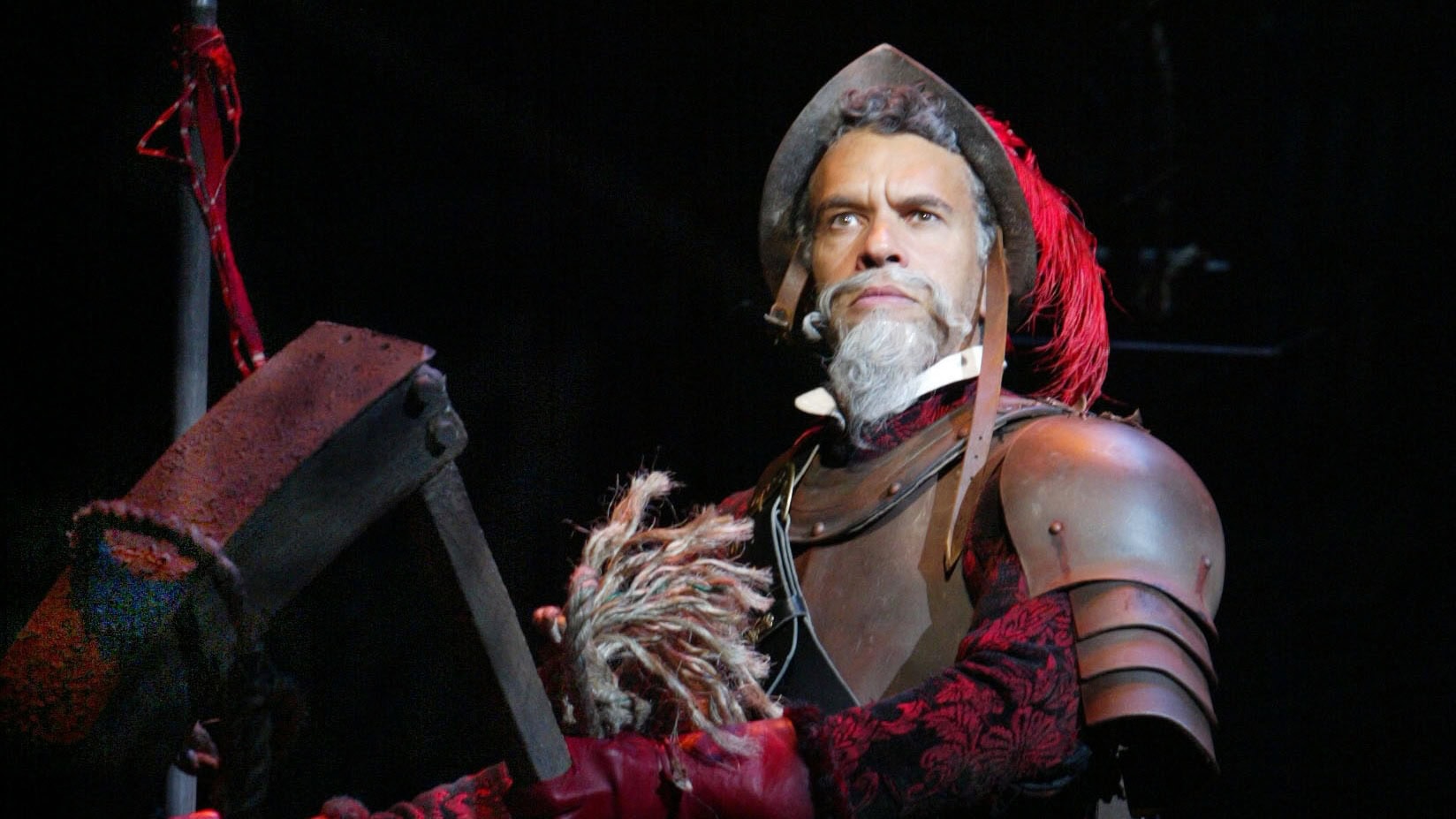
2002 Broadway production of Man of La Mancha (Joan Marcus)
In November 1965, the musical Man of La Mancha (US/UK) premiered on Broadway at the ANTA Washington Square Theatre, wowing audiences and earning rapturous praise from critics. Inspired by Miguel Cervantes’ 17th-century novel Don Quixote, the musical adaptation of Dale Wasserman’s play I, Don Quixote brought the title character to vivid life through a brilliant book and a stunning score by Mitch Leigh and Joe Darion.
Songs like “Dulcinea,” “Little Bird, Little Bird” and “I Like Him” soon found their way into the popular consciousness, filling the air at auditions and cabaret venues. But one song above all others earned its place as a classic of the Great American Songbook, achieving immortality as an anthem of hope and inspiration. That song, of course, was “The Impossible Dream.”
How did this musical theatre treasure come to be, and why does it continue to inspire us 60 years after its creation? Here’s a look at the genesis, history and enduring power of one of the world’s greatest songs.
Creation
Playwright Dale Wasserman’s non-musical teleplay I, Don Quixote premiered on the CBS anthology series DuPont Show of the Month on November 9, 1959. A loose adaptation of Cervantes’ picaresque novel, the play included in its dialogue a poetic phrase of Wasserman’s invention: “To dream the impossible dream; to fight the unbeatable foe.”
When Mitch Leigh and Joe Darion joined forces with Wasserman to adapt his play into a musical, Darion immediately seized upon the phrase, using it as the first line of Don Quixote’s defining song, “The Quest.” A rousing, almost prayerful ode to hope beyond imagination, the song became the show’s anthem, serving not only as the title character’s “I Want” song, but also as the musical’s finale.
Though the writers intended for the song to be called “The Quest,” early audiences connected to the opening lyric, so the song’s title officially became “The Impossible Dream (The Quest).”
Analysis
Rhythmically, “The Impossible Dream” has a Spanish flavor, employing elements of classical bolero. Written in 9/8 time and marked as “Tempo di Bolero,” the song is built on sets of three, with three slow beats per measure, subdivided into smaller groups of three (thus the “9” in 9/8 time). But those nine beats per measure are periodically subdivided into smaller groups of three, giving the piece a driving force. (For those counting along, you can hear the second and fifth beats subdivided, so you get “1, 2-and-a 3 | 4, 5-and-a 6 | 7, 8, 9.”) This driving rhythmic figure contrasts with the soaring, lyrical melody, which adds to the song’s complexity, making it both contemplative and propulsive.
Leigh’s smooth melody rises ever so slowly, working its way from the bottom of the scale to the top, allowing the singer to build intensity gradually, finally landing on the big power notes in the song’s final line, “To reach the unreachable stars.”
Lyrically, Darion employs a simple repetitive structure, beginning with eight matching infinitives, from “To dream the impossible dream” to “To reach the unreachable star.” The pattern then breaks: The song opens up with the statement “This is my quest,” followed by more forceful and powerful language, gloriously taking the lyric through heaven and hell before receding to the idea of “being laid to my rest.”
Lyrics and music then come together gorgeously as the song returns to its opening “A” structure. Quietly looking to the future (“And the world will be better for this”), the song builds quickly to its rousing and powerful climax. It’s a master class in musical theatre songwriting, and it still packs a wallop 60 years after its invention.
Recordings
Richard Kiley introduced the song on Broadway and on the Original Broadway Cast Recording, and his rendition – an emotional, almost desperate plea from a warm, strong baritone – remains definitive.
Popular singer Jack Jones recorded the song in 1966, reaching No. 35 on the U.S. Billboard Hot 100 chart and No. 1 on the Easy Listening chart.
Hundreds of other recordings soon followed, and the song took off in popular culture. Some notable artists who dreamed “The Impossible Dream” include Frank Sinatra (1966), Jim Nabors (1966), The Temptations (1967), Shirley Bassey (1967), Robert Goulet (1967), Diana Ross & the Supremes with The Temptations (1968), Glen Campbell (1968), Andy Williams (1968), Cher (1968), The Smothers Brothers (1968), Sammy Davis Jr. (1969), Roberta Flack (1970), Tom Jones (1970), Elvis Presley (1972), The Mormon Tabernacle Choir (1972), John Cleese and The Muppets (1977), Colm Wilkinson (1989), Luther Vandross (1994), José Carreras (2000), Florence Ballard (2001), Linda Eder (2003), Aretha Franklin (2005), The Mighty Mighty Bosstones (2009), Jennifer Hudson (2009), Susan Boyle (2014), Cynthia Erivo (2016), Josh Groban (2020), Aaron Lazar (2024) and Grace VanderWaal (2024).
Legacy
Man of La Mancha returned to Broadway several times, notably to the Martin Beck Theatre in 2002, when Brian Stokes Mitchell took on the role of Don Quixote (Cervantes). Mitchell has retained his connection to the song ever since, featuring it in his concert performances, and – memorably – from a window of his New York City apartment, where in 2021 he sang the song a capella as the entire city was shut down due to COVID-19.
At the time, the song was just what New York, and the entire world, needed – an anthem of triumph and aspiration, a promise that things can be better, a belief that somehow the unimaginable will happen.
And that is exactly why “The Impossible Dream” has remained so popular and so effective all these years. Leigh and Darion’s song, built from Wasserman’s idea, continues to inspire hope through its sheer conviction that anything is possible, that the fantastic can be achieved, that the stars can be reached. This is the legacy and power of the song: that all of us, no matter our circumstance, can dream the Impossible Dream.
For more information about licensing a production of Man of La Mancha, visit Concord Theatricals in the US or UK.
We Create Our Own Ghosts: Playwright Nikhil Mahapatra Talks Love You More
Nikhil Mahapatra’s modern take on a Shakespearean classic explores sibling rivalry, grief and returning home. In this interview, the playwright discusses their creative process and how this sharp play came to be.
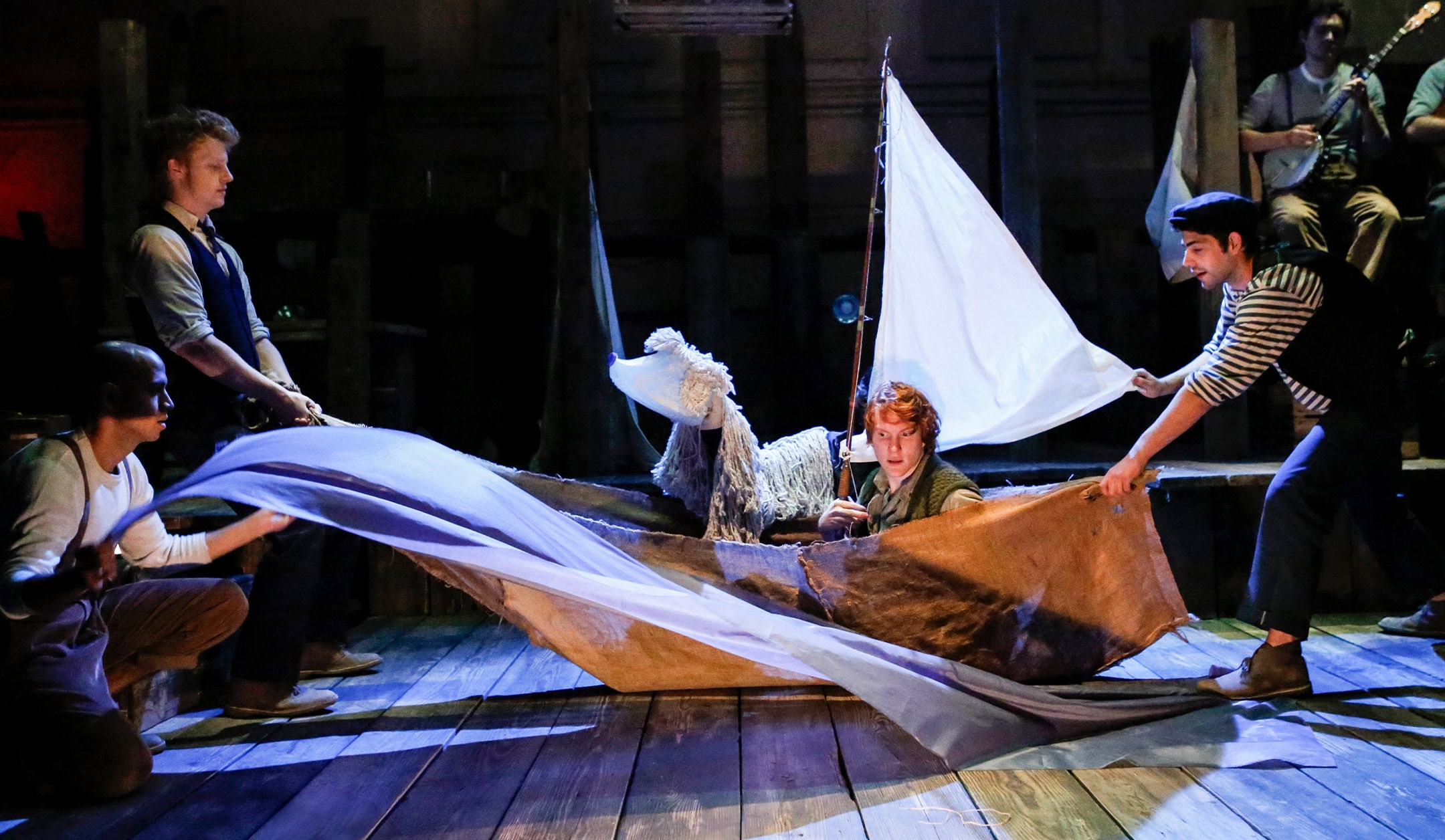
Shows Featuring Puppetry
Puppetry has been part of theatre and storytelling for centuries. In this article, discover a range of shows for a variety of audiences – and performers! – all with great opportunities for puppetry.
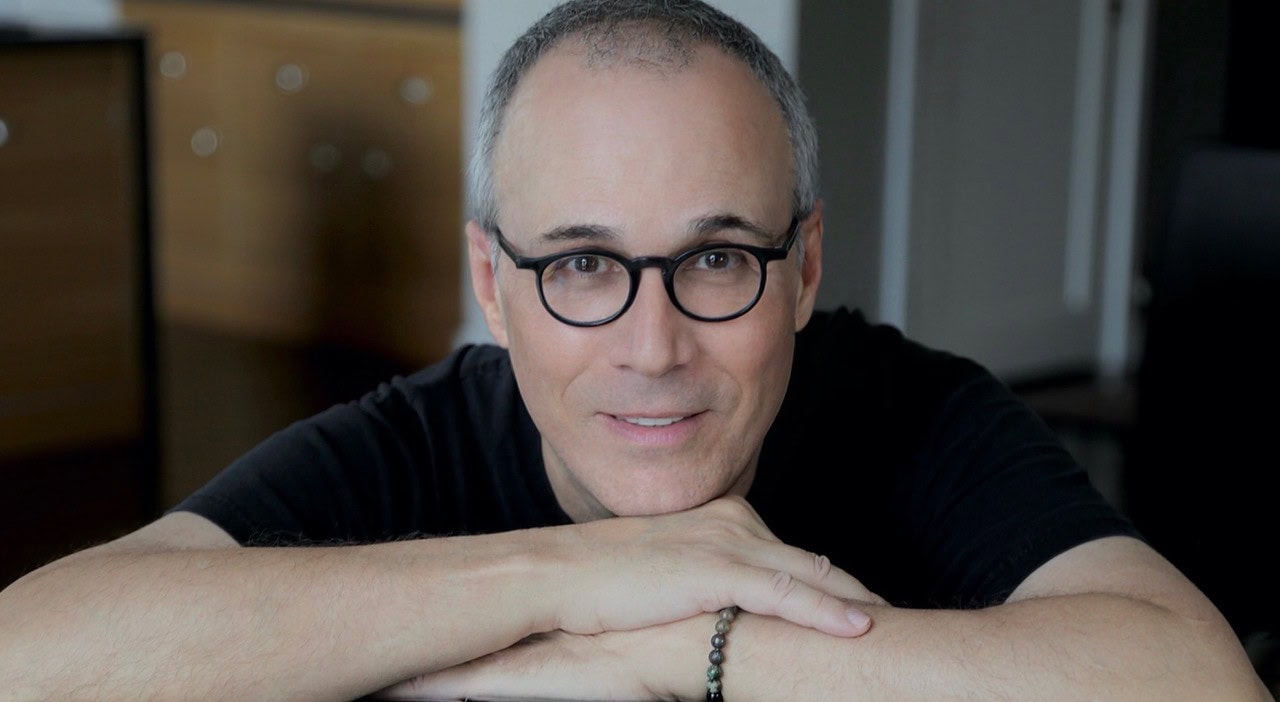
A Conversation with John Bucchino
John Bucchino, composer/lyricist of A Catered Affair, It’s Only Life and A Peacock Among Pigeons, reflects on the influences and creative instincts that have shaped his warm, vulnerable and meticulous work.