
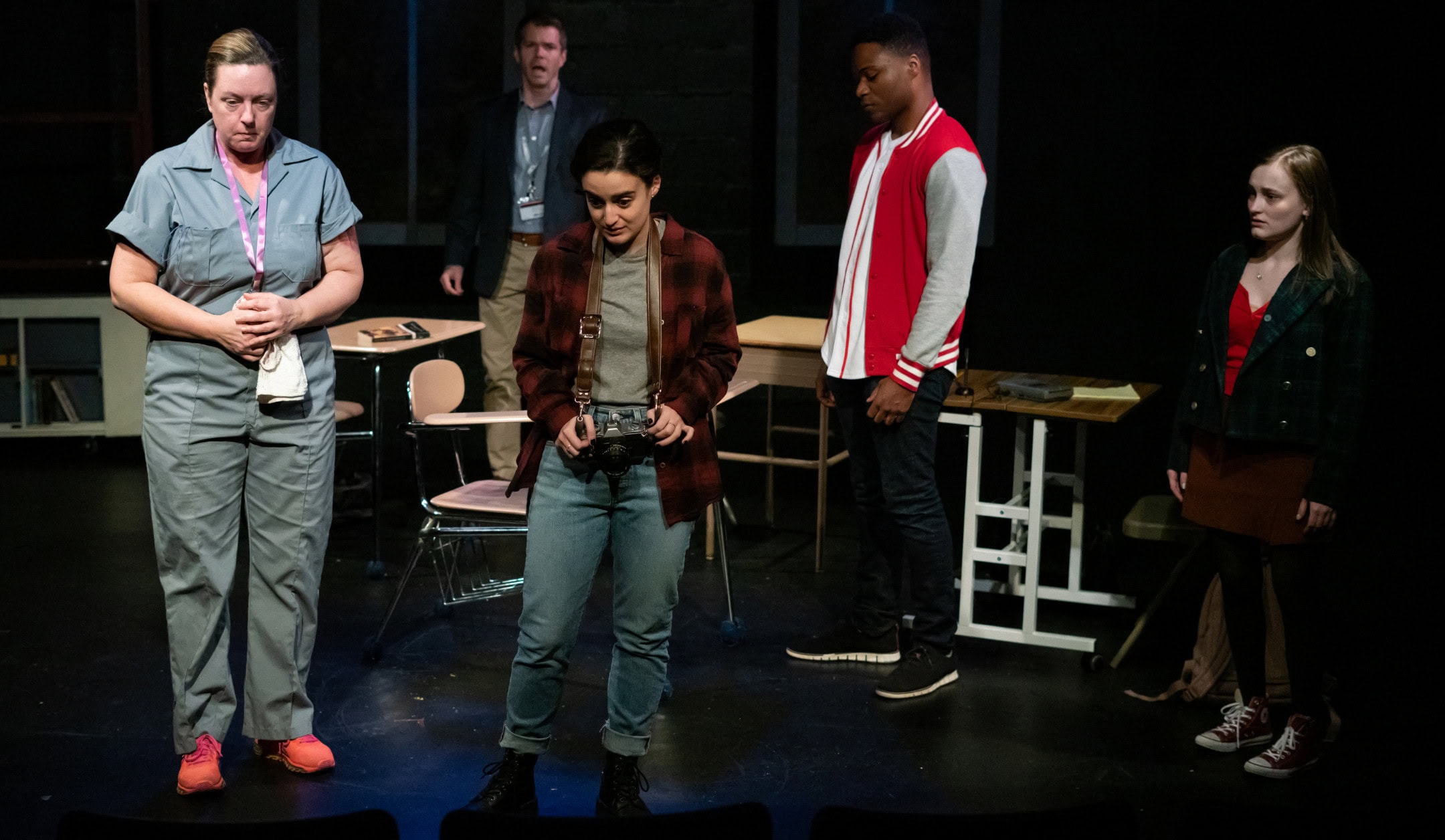
2020 Off-Off-Broadway Production of Faculty Portrait (Lenny’s Lens)
In this edition of the “In Conversation with…” series, Breaking Character presents a sampling of shows that respond to a kind of tragedy that has sadly become a common reality and the leading cause of death for children and teens in the United States: gun violence.
According to the latest data from Centers for Disease Control and Prevention (CDC) and Pew Research Center, around 44,000 people died at the hands of gun violence in the United States in 2024. According to The Trace, in the first three months of 2026, over 3,100 people died due to gun violence and 94 mass shootings occurred – both lower figures than the year prior, and yet still far too many precious lives lost.
The problem is daunting, but despite it, theatre continues to mindfully engage with the issue of gun violence. From the perspective of younger generations growing up with frequent active shooter drills to the view of parents related to those responsible for these tragedies, each of the shows below has its own lens to share. Whether by commenting on the causes of gun violence, the events themselves, the complex feelings that come in the aftermath, or the preventative steps we can take to ensure the safety of our communities and loved ones, these plays challenge us to acknowledge the grief of these shared experiences. They also ask us to examine how humanity makes sense of such a great loss and begins to heal or forgive, and even to come together to explore how to keep these tragedies from continuing.
Explore the selection of plays below and challenge yourself (or your theatrical community) to engage thoughtfully with the kind of violence that affects hundreds of Americans every year and discover the capacity for change, hope and forgiveness in the face of it all.
Plays
26 Pebbles by Eric Ulloa (US/UK)
(Full-Length Play, Drama / 4w, 2m)
The play: On December 14, 2012, Adam Lanza walked into Sandy Hook Elementary School and killed 26 innocent souls before taking his own life. These 26 innocent deaths, like pebbles thrown into a pond, created ripples and vibrations that were felt far beyond the initial rings. This is the story of those vibrations. Similar in style to The Laramie Project, playwright Eric Ulloa’s powerful response to the 2012 shootings at Sandy Hook in Newtown, Connecticut, is a riveting and heartbreaking docudrama – compiled from real interviews with community members – crafted together into a thoughtful and personal exploration of violence, loss, hope and humanity.
On Gun Violence: Playwright Eric Ulloa first heard about the tragedy in Newtown on the news on his way to bartending a company’s holiday party and watched on his phone as the story grew impossibly horrific in scope. Tired of standing on the sidelines and being helpless, he thought, “If my art can help even one person, well, wouldn’t that be the reason to want to continue to make it?” So, he conducted 60 interviews and wrote his first play, 26 Pebbles. This piece engages with the specific event at Sandy Hook as well as the wider issue of gun violence in schools in an ensemble way, utilizing an ensemble cast to show how the community on the whole moved through the incident and its aftermath.
Read more about 26 Pebbles in “Community and Growth: A Conversation with 26 Pebbles author Eric Ulloa.”
Faculty Portrait by Sean David DeMers (US/UK)
(Full-Length Play, Drama / 4w, 2m)
The play: A year after a school shooting claimed the life of his wife, Mr. Y finds himself teaching in the same classroom where the tragedy occurred. As he is interviewed for the school yearbook, Mr. Y revisits the true horrors of the shooting with three students tied to the event. As their memories flash back to the shooting and the events leading up to it, their shared guilt is in turns heightened and assuaged until they accept the mistakes of the past.
On Gun Violence: This play’s assessment of gun violence balances the issues of guilt and hope in a manner that is not overly saccharine, and it is this direct address of the trauma and grief of a teacher who lost his wife to a school shooting that makes it a profound choice. While we often rightfully focus on the lives of children lost, the substantial scenework available in this play offers the chance to engage with painful remembrances of adults lost to tragedy – all the more haunting if caused by brave, selfless acts. The play’s overall message posits that the best way to recover from grief is together and is accomplished with episodic oscillation between then and now as well as a strong sense of dialogue and pace.
Gloria by Branden Jacobs-Jenkins (US)
(Full-Length Play, Drama / 3w, 3m)
The play: This funny, trenchant and powerful play follows an ambitious group of editorial assistants at a notorious Manhattan magazine, each of whom hopes for a starry life of letters and a book deal before they turn thirty. But when an ordinary humdrum workday becomes anything but, the stakes for who will get to tell their own story become higher than ever.
On Gun Violence: The intersection of media and gun violence becomes personal in this play when a group of editorial hopefuls experiences a shooting in their very office. The pacing of the play never slows, moving quickly through instances of casual homophobia, racism, and later the gun incident to mirror the ways in which American daily life has become so inundated with these instances of violence that they have become flippant and commonplace – and even a hot story to write about. Through its balance of humor, shock and tragedy, the play asks audiences to consider whose stories we get to claim and how we treat each others.
Natural Shocks by Lauren Gunderson (US)
(Full-Length Play, Drama / 1w)
The play: Angela is trapped in her basement, waiting out an approaching tornado. Though a self-proclaimed unreliable narrator, she begins to reflect on a lifetime of trauma, illuminating the truth behind her endangerment. Based on Hamlet’s famous “to be or not to be” soliloquy, this one-woman show is a damning condemnation of violence, abuse and firearms in America.
On Gun Violence: According to The National Intimate Partner and Sexual Violence Survey, two in five women (41%) and one in four men (26%) experienced at least one impact from this kind of violence in their lifetime. When guns are added to the equation, nearly 70 women per month are murdered by their intimate partner with a gun, and 4.5 million women have been threatened with a gun by an intimate partner, as collated by the 2024 Domestic Violence and Firearms Report. Gunderson’s one-woman play takes on the enduring issue of gun violence and its intersection with domestic violence in the U.S and was written just two weeks before the shooting at Parkland. This play made its way into the world in 2018 by premiering in 48 states across the country in a series of more than 100 free readings to raise funds and awareness for gun violence prevention and domestic assault awareness.
Office Hour by Julia Cho (US)
(Full-Length Play, Drama / 2w, 2m)
The play: Gina was warned that one of her students would be a problem. Eighteen years old and strikingly odd, Dennis writes violently obscene work clearly intended to unsettle those around him. Determined to know whether he’s a real threat, Gina compels Dennis to attend her office hours. But as the clock ticks down, Gina realizes that “good” versus “bad” is nothing more than a convenient illusion, and that the isolated young student in her office has learned one thing above all else: For the powerless, the ability to terrify others is powerful indeed.
On Gun Violence: Inspired by the real-life events surrounding the 2007 mass shooting at Virginia Tech, this play examines the question many ask in the aftermath: What could we have done to prevent this? By presenting the character of Dennis with detail and humanity while not shying away from the danger inherent in his access to a gun, this piece becomes not a political stance on gun rights but rather a nuanced work that offers complex, human characters and no obvious answers to the aforementioned question.
On the Exhale by Martín Zimmerman (US/UK)
(Full-Length Play, Drama / 1w)
The play: When a senseless act of violence changes her life forever, a liberal college professor finds herself inexplicably drawn to the very weapon used to perpetrate the crime – and to the irresistible feeling of power that comes from holding life and death in her hands. Peering down the barrel of a uniquely American crisis, she begins to suspect that when it comes to gun violence, we’re all part of the problem.
On Gun Violence: The personal, palable emotion that comes from the solitary focus on a mother who lost her child to a school shooting brings a visceral quality to this work. The use of only one actor – and thus only one perspective – to explore the tragedy that is gun violence brings a dynamic tension to the topic, forcing the audience to sit with her story and see themselves reflected in her grief.
Our Play by Jessica Moss (US/UK)
(Full-Length Play, Dramatic Comedy / 6w, 5m, 3gnc)
The play: A group of high school students mount a production of Thornton Wilder’s Our Town, mirroring the classic’s style and structure in three acts: rehearsal, opening night and the tragic school shooting that follows. This is a beautiful inspection of high school adolescence, the community found in a high school theatre, and the hopes and fears of growing into a life.
On Gun Violence: This conversation with school shootings lends its voice to today’s youth and retains an inspiring, hopeful tone despite it all. While it describes a school shooting in detail, it is done with a tact that allows for students to dually process the real violence they have grown up all-too-familiar with as well as remind them of some of the joys of life in adolescence that they will remember for years to come. Written with heart for an inclusive, ensemble cast of high school-aged characters, this is a play that is accessible to and potentially transformative and fruitful for college performers to tackle.
Pluto by Steve Yockey (US/UK)
(Full-Length Play, Drama / 3w, 2m)
The play: In the wake of a local tragedy involving gun violence at a community college, single mother Elizabeth Miller and her withdrawn son, Bailey, try to jump-start their relationship across the breakfast table. But with berserker appliances, shifting astronomy and the talkative new family dog’s interruptions, Elizabeth might not be able to really “see” the person she needs to see most.
On Gun Violence: This play’s mix between kitchen sink realism and surrealistic, dream-like states in its scenes allows for the breadth of emotions in the wake of these tragedies to be explored more fully. The combination of mythology, supernatural and horror elements provides a truly affecting experience that feels epic, yet its strong mother figure and her dialogue with her son offers an intimate and human counterbalance. Instead of explaining or excusing, it simply humanizes, and with a bit of humor that adds to the audience’s experience of such a weighty topic.
The Amish Project by Jessica Dickey (US/UK)
(Full-Length Play, Drama / 1w)
The play: This fictional exploration of the real Nickel Mines schoolhouse shooting in an Amish community tells the story of violence’s impact on a community and the path forged in its wake. Rich in research about the Amish culture in Pennsylvania and filled with the deep heart they carry, this play focuses on the Amish response to this particular crime: forgiveness. In the original production, all of the roles – from the 14-year-old victim of the shooting to the widow of the gunman to the wider members of the Amish community to the gunman himself – were played by just one actress (originally, the playwright Jessica Dickey herself!), bringing an exercise in human empathy into sharp focus. By using just one actor, the performance asks us to see the humanity in the gunman, as he is played by the same actor as the young girls who died at his hands, and challenges the audience to exercise the surprising forgiveness that the Amish community expressed in the wake of this tragedy. The play can also now be performed with an ensemble cast (US/UK), expanding the theme of community compassion to a larger group of actors.
On Gun Violence: Playwright Jessica Dickey felt moved to write this piece because of a particularly personal impetus: It happened near her hometown in Pennsylvania. Instead of interviewing people close to the tragedy, Dickey remarked, “I just did not want to ask anything more of people that were carrying something so large, something I couldn’t fathom carrying. So I took the initial facts of the crime and then created fictional people and a fictional world for the play. At the time, the story was always in the news and the survivors and families were begging just to be left alone. Creating a fictional world let me give them the peace they were asking for, while also allowing me to write the story through the lens of my own heart; I was a new writer and that ended up being an important stroke in the play and how it came forward.”
You can read more about the playwright’s perspective on this play in the Breaking Character article “Forgiving Gun Violence: The Amish Project Ten Years Later.”
The Door by Amy E. Witting (US/UK)
(Short Play, Drama / 1w, 11 any gender)
The play: This world premiere one-act written specifically for today’s students tells a story of hope under extraordinary circumstances. It’s an ordinary Thursday in a classroom in America – not FDR’s America, this America – and a classroom of eleven students named for colors of the rainbow must grapple with surviving the “new imaginable” in the aftermath of a school tragedy. The play first premiered off-Broadway at the Keen Teens Festival of New Work in May of 2025, where professional playwrights are commissioned each year to write plays with roles specifically for teenage actors.
On Gun Violence: While this play addresses sensitive topics, its roots lie in magic, hope and love. In this selection, the school shooting is described in careful narration rather than acted out in real time, giving the production control over how overt or subtle to make the moment. It is also the first moment of the play, which immediately gives way to a magical door that each student will walk through to a more dreamlike realm. This magical space is where much of the action takes place, and the majority of the time in the play is spent exploring the students’ thoughts, dream, hopes and worries here.
The Gun Show by E.M. Lewis (US/UK)
(Full-Length Play, Drama / 1 any gender)
The play: In this solo show, award-winning playwright E.M. Lewis tells the story of America’s relationship with guns through the prism of her own personal experiences. From a farming community in rural Oregon to the big cities of Los Angeles and New York, an actor shares Ms. Lewis’s unique perspective and true stories about America’s most dangerous pastime as if they were his or her own, with brutal honesty and poignant humor. Leaning neither right nor left, The Gun Show jumps into the middle of the gun control debate and asks, “Can we have a conversation about this?”
On Gun Violence: The play’s conversation zooms out from one singular instance of gun violence to be in conversation with gun control on the whole, and its use of one actor to embody all sides of the debate – similar to The Amish Project – establishes a balanced conversation that allows a variety of opinions on the issue a space at the table. The play has a certain amount of flexibility in style of presentation, but it’s meant to be simple and direct, allowing for the solo actor to directly be in conversation with the audience through both monologue and a few small instances of audience interaction.
This Flat Earth by Lindsey Ferrentino (US/UK)
(Full-Length Play, Dark Comedy / 1w, 2m, 1 girl, 1 boy)
The play: At a middle school in this seaside town, the unthinkable has happened, placing a bewildered community in the national spotlight. Stuck at home in a state of shocked limbo, Julie and Zander, two thirteen-year-olds, try to make sense of the chaos they’ve witnessed, their awkward crushes, and an infinitely more complicated future – but the grown-ups are no help at all. An urgent response to our times, This Flat Earth is a startling and deeply felt story of growing up in our confounding world.
On Gun Violence: This play focuses on the echo of instances of gun violence and how it reverberates in people’s lives. Specifically, its teenage characters slowly come to realize that what’s happened to them has happened to other teenagers, and their questions and convictions grow from that realization. In this perspective, it holds the particular next to the universal, allowing the actors to live out these characters’ specific responses to gun violence while also asking the questions that many of us end up asking: Why is this still going on, and why don’t the grown-ups just fix it? A solid option to allow teenage actors to be in conversation with adult actors.
Truth Be Told by William Cameron (US/UK)
(Full-Length Play, Drama / 2w)
The play: Kathleen Abedon’s teenage son Julian carries an automatic weapon into his workplace and opens fire. When the smoke clears, 14 people are dead, Julian among them. One year later, when true-crime writer Jo Hunter comes to town to interview Kathleen for a book on the shooting, the grief-stricken mother seeks to convince the skeptical journalist that Julian has been framed for the shooting. At a time in our history when the truth is under attack on a daily basis, Truth Be Told explores the nature of objective truth and the ways in which we manipulate and distort it to serve our own ends.
On Gun Violence: Instead of the focusing on the parent of a child lost to gun violence like On the Exhale, this play asks us to focus on the mother of the gunman, whose son was also a teenager and also died due to his choice to enact gun violence, and complicates it by putting her in conversation with a journalist meant to cover the incident. This gripping perspective asks audiences to examine the complexity of grief and of truth for the parents of the perpetrators of these violent moments as well as the role media plays in portraying tragedy. The playwright leads us deep into the psychology behind these two women, whose versions of the truth are at odds with one another, in this taut and expertly-crafted exploration of conflicting realities.
Until the Flood by Dael Orlandersmith (US)
(Full-Length Play, Drama / 1 any gender)
The play: Pulitzer Prize-finalist Dael Orlandersmith’s Until the Flood was written in response to Michael Brown’s death, a teenager who was shot and killed by a police officer in Ferguson, Missouri, on August 9, 2014. In this gripping and revelatory drama based on interviews from the aftermath of the shooting, Orlandersmith journeys into the heart and soul of modern-day America – confronting the powerful forces of history, race and politics, and embodying the many faces of a community rallying for justice, and a country still yearning for change.
On Gun Violence: In response to the tragedy in Ferguson, playwright Orlandersmith interviewed scores of St. Louis residents about the social unrest and wove their stories together, using her signature well-researched and people-forward documentary drama style to piece together the voices of the diverse community members she interviewed. In doing so, the eight distinct characters in this play do not directly represent any one St. Louis citizen but instead are fictionalized collations of the thoughts and sentiments most important to those part of the community. In this way, no individual person had to represent the entirety of the response to the event and allows for the truth of imagination to combine with the truths important to the community to meaningfully engage in the conversation about gun violence.
Collections
ENOUGH! Volume 4 by Abby Dougherty, Matias Finley, Ian Hodges, Payton Aurora Jones, Pace Rundlett, Elizabeth Shannon, Olivia Stanley and Wyn Alyse Thomas (US/UK)
(Collection / Anthology, Drama / 4w, 3m, 2 any gender)
The plays: These collections of short plays are created as part of the ENOUGH! Plays to End Gun Violence program, which creates space for teens to confront gun violence by creating new works of theatre that will spark critical conversations and inspire meaningful action in communities across the country. Their mission is to promote playwriting as a tool for self-expression and social change, harnessing this generation’s spirit of activism and providing a platform for America’s playwrights of tomorrow to discover and develop their voices today. This fourth volume in the ENOUGH! series includes six 10-minute plays written by teens, offering the generation most impacted by gun violence’s perspective on the issue, including:
Oh Look, Another School Shooting! by Matias Finley (US/UK)
(10 Minute Play, Drama / 1m, 5 any gender)
After a shooting, whose story takes center stage? The victims? The shooter? Or everybody watching? A young student is forced to face the chilling reality that when truth becomes subject to competing agendas, healing becomes an afterthought.
The Perfect Victim by Payton Aurora Jones (US/UK)
(10 Minute Play, Drama / 1w, 1m, 4 any gender)
Between the bullet and the obituary are a hundred split-second decisions. For honor-student Malik and his best friend, Jay, the aftermath of a gunshot reveals the fragility of flawed systems, the strength of connected community, and the injustice of stolen youth.
We Didn’t Have to Meet Here by Pace Rundlett (US/UK)
(10 Minute Play, Drama / 2w, 3m)
Four strangers meet in an unfamiliar place with absolutely nothing in common… except for the fact that they’re dead. And before they can move on, they need to understand why. A moving portrait of the stories behind the statistics in an all-American epidemic.
Nobody Cares About Death by Ian Hodges (US/UK)
(10 Minute Play, Dark Comedy / 1w, 1m)
Death has written a book, and boy, does he have a lot to say. In his first televised interview, Death reveals he’s been getting a lot busier lately – and he’s really sick of visiting schools. A searing look at the cycles of violence we’ve grown too numb to break.
Under Wraps by Olivia Stanley (US/UK)
(10 Minute Play, Drama / 4w, 1m, 1 any gender)
In a young woman’s all-too-familiar story, a lyrical love ballad twists into a nightmare of violence, secrecy and deception. A haunting, richly poetic reminder that the pain we hide unravels us all in the end.
Holding Space by Abby Dougherty (US/UK)
(10 Minute Play, Drama / 2w)
When tragedy strikes, how do you respond? Thrown together after a school protest goes wrong, Katherine and Lucy must figure out what’s right as they confront their limits – and their potential – for making change.
On Gun Violence: In this volume created in 2025, teenagers in that year chose topics they wanted to explore related to gun violence in the now. These include how healing becomes an afterthought when we politicize violence, the injustice of stolen youth, what conversations those who have died at the hands of gun violence would have, how personifying Death allows us to poke at our numbness to this cycle of violence, how hiding our pain unravels us, and what our limits and potential for change are and can be. These teenagers – who have done active shooter drills since elementary school and lived through dozens of school shootings featured on the news – felt these topics were important enough to write about, and this subject is not just theoretical to them anymore. Their voices – and genuine worries – deserve to be heard.
Other collections in this series include #ENOUGH (US), #ENOUGH: Every Fifteen Minutes (US) and ENOUGH! Volume 3 (US/UK).
For more moving and powerful plays, visit Concord Theatricals in the US or UK.
Shows for Every Audience
Warm and inviting, these shows are an accessible way to experience the magic of live theatre. For any age and any background, they’re sure to delight audiences and give actors a chance to shine.

Thank You, Teachers
To honor the wonderful educators who motivate young theatre artists, Concord Theatricals authors thank their most inspiring teachers.
College Theatre: Consider These Plays & Musicals, Fall 2026
Choose your next show from this wide selection of plays and musicals for colleges and universities, including incisive political dramas, charming rom coms and cutting-edge musicals.