
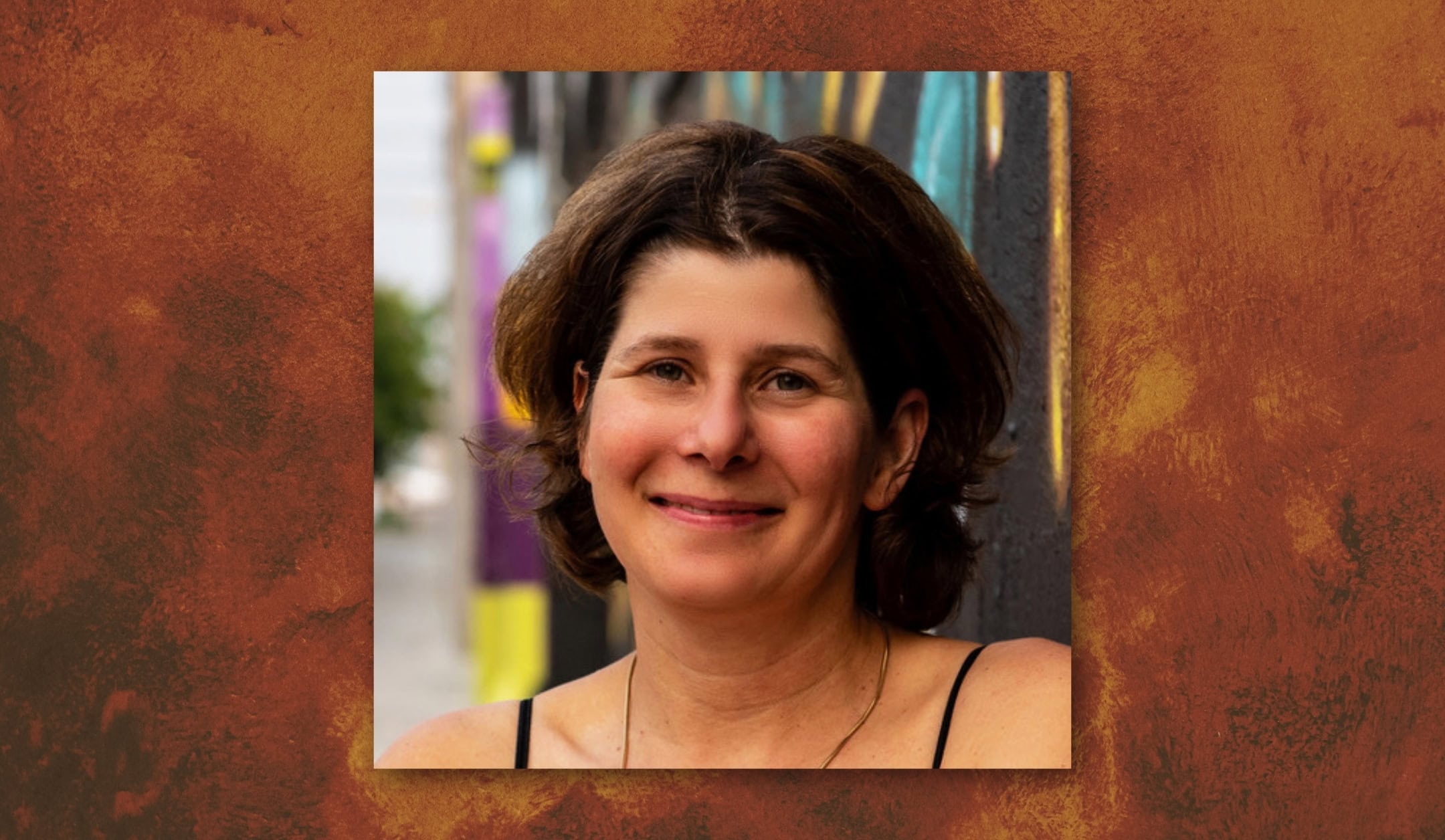
An acclaimed playwright who has been awarded the Oregon Book Award in Drama three times, Andrea Stolowitz creates work that encompasses the full spectrum of human emotions, from heartbreaking loss to moments of warm intergenerational connection to frankly-expressed frustrations. Her 2016 work, The Berlin Diaries (US/UK), is the moving tale of her own family history, tracing the path of her great-grandfather, Max, a German Jew who escaped to New York City in 1939. Though Max’s story was “verschollen,” or lost, Stolowitz uses his journal as a guide, winding her way across continents and decades in a moving combination of docudrama and biography in which two actors play 14 characters. We spoke to the playwright to discuss her process, sitting with heavy emotions on stage and how stories can persist through the decades.
How would you describe yourself as a playwright?
Andrea Stolowitz (AS): I am a Jewish playwright, and I like to experiment with form to make what we think we know feel fresh again. I’m interested in how large historical and political events enter our private lives and shape our most intimate relationships. My work often begins with an investigation: an interview, an archive, a question I can’t answer. Finding the theatrical form is part of that investigation. And I’m very funny. Even when the subject is difficult, humor finds its way in.
The stories that comprise The Berlin Diaries are those of your own family – have you always been a playwright who combines the personal with the theatrical?
AS: My work is personal in the sense that the questions matter deeply to me, but it isn’t always autobiographical. I also work with interviews, other people’s experiences and invented characters. In The Berlin Diaries, my own family became the subject, and I became a character. That creates an interesting problem: the Andrea onstage has to be allowed to be impatient, mistaken, funny and limited in her understanding. She can’t simply be the author explaining what everything means. The audience needs to discover things alongside her and sometimes see things before she does.
Could you talk us through the process of archival research that inspired The Berlin Diaries? Was it brought directly to the stage, or were there elements you changed for theatrical effect?
AS: The starting point was my great-grandfather Max’s diary, which my mother had donated to the United States Holocaust Memorial Museum. I went to Berlin to investigate the people and places he described. The research involved archival records, conversations with relatives and following connections that had become difficult to trace across generations and countries. The diary gave me a way into that history, but it also raised questions it couldn’t answer.
The theatrical challenge was how to make the experience of searching live onstage. A collection of documents doesn’t automatically make a play. The dramatic structure brings my investigation into conversation with Max’s account of his life, allowing different times and places to exist beside one another. The uncertainty matters: the audience experiences the gaps, the interruptions and the frustration of wanting an answer that a document cannot give you.
When Max’s – your great-grandfather’s – diary is first revealed, we hear the inscription, “I dedicate this film of my life.” What is the importance you place on memory and testament, both in and outside theatre?
AS: What moves me about that dedication is that he is imagining someone receiving his story. Writing becomes an act of reaching toward a person he may never meet. There is something profoundly hopeful in that.
But a testament is also a particular person’s account. It contains what they could remember, what they could bear to say and what they thought someone else needed to know. I’m interested in listening to it carefully while also noticing its silences. Theatre gives that process a physical life. An actor speaks the words, another person listens, and something written long ago becomes an encounter in the present.
The Berlin Diaries features an incredible interplay of lines within the text, almost giving the effect of one unified familial voice echoing through time. Why did you choose to filter so many different characters through two actors?
AS: The two actors share all the characters, including Andrea and Max. Even a single thought can move from one performer to the other. That means the audience can’t permanently attach a person to one body, one gender, or one generation. You have to keep listening.
That feels connected to the way family history lives within us. We carry other people’s words and habits, sometimes without knowing where they came from. The form lets us experience those connections while still encountering distinct people. It also makes the act of telling visible: These two performers need each other to construct the story. Nobody can tell it alone.
Themes of generational loss and trauma run through The Berlin Diaries. How do you sit with these heavy emotions as a playwright, and how do you want audiences to sit with them?
AS: The way into those emotions, for me, is through something specific: a conversation, a name, a question someone won’t answer. Those details give us a relationship to loss that can otherwise feel too enormous to approach.
The work of making the play also gives the emotion a form. There are decisions about rhythm, language and what happens next. For an audience, I want room for different responses. They might feel grief, curiosity, recognition, or frustration with Andrea. I don’t want to prescribe the correct feeling; I want to create enough attention and connection that they’re willing to stay with the difficult material.
We hear the “Andrea” of the play ask her great-grandfather “why are you making me the one?” to bear these secrets. Could you elaborate on what seems to be the trauma of knowledge in isolation?
AS: Learning something about your family can change your relationship to people who haven’t made that discovery with you. You may urgently need to talk about it while someone else needs to leave it alone. That difference can be very lonely.
For Andrea, discovery brings a sense of responsibility. Once she knows, what does she owe these people? What is she supposed to do with their stories? “Why are you making me the one?” contains love, but also resistance and anger at being given a task she didn’t understand she was accepting. Making a play allows that knowledge to become shared. It doesn’t resolve the loss, but it creates other witnesses.
Despite the somberness of its narrative, this is still a work with continual glimpses of humor, from Moishe to Max’s poem to the clerk talking about data protection issues with the “verschollen.” Was it important to you to introduce levity to pay homage to the fullness of how people cope with grief?
AS: Yes, although I think the humor belongs to the people and situations themselves. Max writes a poem about hemorrhoids! That detail gives us a person with a body and a sense of humor, someone who exists beyond the historical tragedy we associate with his life. The absurdity of the clerk’s concern with data protection also emerges directly from the situation. I want to preserve that fullness of human experience. Grief doesn’t eliminate humor; sometimes they live very close together.
Near its climax, the play itself asks, “How do you measure the value of family?” How would you answer your own question?
AS: I think the play tests the possibility of measuring it at all. What is the value of discovering a relative you never knew existed? How do you account for a relationship that history prevented you from having?
For me, the question becomes one of attention and responsibility. What happens when someone who was only a name becomes a person to you? What are you willing to do to sustain that connection? Family can be difficult, and discovering a connection doesn’t automatically create closeness. But it can enlarge your understanding of who belongs in your life and whose absence has shaped it.
What does it mean to you to produce a play dealing specifically with Jewish identity and history in these times?
AS: It feels important to make room for Jewish life in its specificity and complexity. I’m telling the story of a particular family, with its own silences, disagreements, humor and ways of surviving. I don’t speak for every Jewish person, and I wouldn’t want any one story to carry that expectation.
I’m also conscious of how quickly assumptions can enter a room when Jewish identity is named. Theatre offers time to encounter actual people and stay with what is complicated about them. My hope is that this play makes space for curiosity and conversation, including conversations that are uncomfortable. I want to be able to explore Jewish identity as an artist with the full range of questions and formal possibilities that any subject deserves.
If there’s one thing you’d want audiences to take away from your play, what would it be?
AS: I’d like them to leave curious about someone in their own family whom they thought they already understood. Perhaps there’s a question they’ve never asked, a story they’ve stopped listening to, or a silence they’ve taken for granted. You may never recover the whole story. But the act of asking and listening will change your relationship to another person over time and those who come after you.
To discover more about Andrea Stolowitz and her thoughtful, compelling work, visit her author page in the US or UK.

Thank You, Teachers
To honor the wonderful educators who motivate young theatre artists, Concord Theatricals authors thank their most inspiring teachers.
College Theatre: Consider These Plays & Musicals, Fall 2026
Choose your next show from this wide selection of plays and musicals for colleges and universities, including incisive political dramas, charming rom coms and cutting-edge musicals.

Jen Silverman in Five Plays
Explore award-winning playwright, novelist and screenwriter Jen Silverman’s range of writing through a selection of five of their plays below, each of which bring an interesting yet complex character, bold comedy or poignant theme to life.