
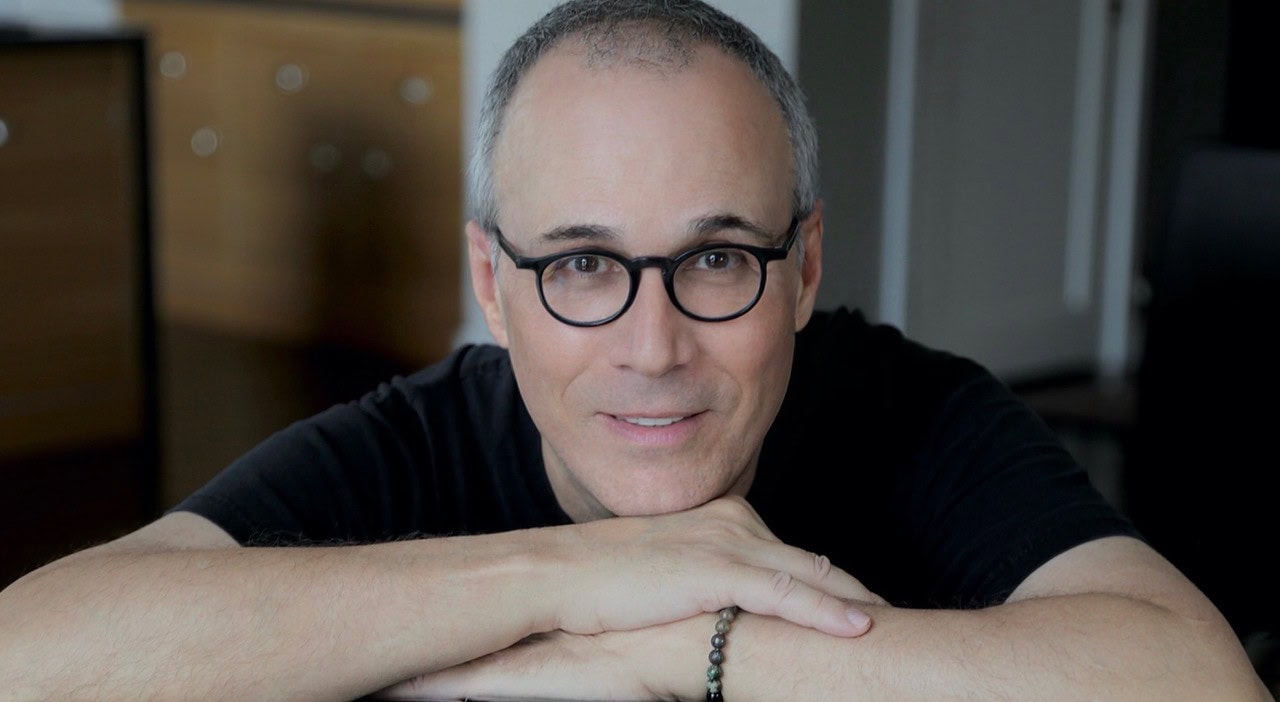
Songwriter John Bucchino’s work, beloved for its warmth and vulnerability, and admired for its meticulous craft, has found a home in theatres, cabarets and concert halls. Concord Theatricals proudly represents his A Catered Affair (US/UK), It’s Only Life (US/UK) and A Peacock Among Pigeons (US). We recently sat down with John to reflect on the influences, turning points and unique creative instincts that have shaped his work – making us all truly grateful for the talents he’s shared with us over the years.”
When you think back to your earliest experiences with composing, what were the moments that made you realize songwriting was going to be your language?
When I was a baby in South Philly, we lived next door to my mom’s parents. My Nana would babysit me while both parents went to work. In her living room was a big black upright piano on which my mom and her sister had taken piano lessons for a short time as kids. As soon as I could reach the keys, it became my favorite toy. I began plunking out the melodies of nursery rhymes and Christmas carols, to which I eventually added chords. My ear picked up more and more complex musical ideas, which I would figure out how to recreate. It was an organic growth process. When I was 9, my parents thought it would be appropriate for me to have piano lessons. This did not go well. I had already developed my own relationship with music which had nothing to do with little black dots on a page. And it didn’t help that the teacher was a taskmaster who refused to acknowledge anything I did by ear. The dots swam before my eyes and I just couldn’t connect them to my hands. Moreover, I didn’t want to. Reading music felt like being less than I was and I hated it. After a few lessons, I refused to take any more, and continued to figure things out in my own way, by instinct rather than intellect.
When I was 13, we (shockingly!) moved to Palm Desert, CA and my parents could not afford to bring my huge upright piano with us. At such a pivotal age, I was suddenly without my musical security blanket, the only “safe space” in which I had any control. It was a traumatic time: new state, new public school (as opposed to the Catholic schools I had attended till then), and bullies increasingly torturing me for my funny accent, timidity, “otherness.”
When I was 15 or so, my mom entered a poem in a radio contest and won a nylon-string guitar which, not having a piano, I taught myself to play. By then, thankfully, I had found a group of friends who all played guitar and loved, as I did, the pop music of the time: The Beatles, Carole King, James Taylor, Stevie Wonder, Led Zeppelin, Simon and Garfunkel, etc. I would figure out how to play these songs and then teach them to my friends. In emulating our pop heroes, we eventually began writing our own songs. One of my first attempts, at age 16, was a collaboration with my friend Pete on a song called “Appendectomy” in honor of our friend Chuck who was in the hospital having one. I still recall some of the profoundly poetic lyrics: “The doctor told us that you’re going to die / So we thought we’d write a little song to say goodbye… / Oh, appendectomy, appendectomy / And with your cooperation they perform the operation / Appendectomy, appendectomy / Seven thousand million stitches they put in above your britches / Now you’ve got a pocket for your picks.” There was nowhere to go but up.
When I was 16, my parents bought me a used Estey spinet piano, and I began writing more songs now that I finally had a keyboard. I begged them for a Sony sound-on-sound tape recorder so that I could record what I was writing, and for my 17th birthday, as an early graduation gift, they gave me the recorder. I was in heaven! While not actually a multi-track recorder, one could achieve the effect of multiple tracks by “bouncing” from left to right side. Since there was no mixing capability, I would first record whatever basic accompaniment sound I wanted (usually piano or my Wurlitzer electric piano which I’d bought from a friend), then bounce that track while recording the next-loudest sound (maybe bongo drums), then maybe guitar, then harmony vocals and finally, because it needed to be the most prominent, the lead vocal. Once a new track was recorded, the volumes of the tracks before it were unchangeable, so there was always an unnerving degree of unpredictability as to the balance of sounds in the finished product. I began experimenting with recording instruments at slower speeds so they’d sound interesting when played at tempo and, forever inspired by The Beatles, eventually played with backward sounds and “found” sounds such as the dishwasher.
My dream was a career of writing songs, recording them in state-of-the-art studios with the best engineers and side musicians, and releasing albums that would have enough of a following to afford me the opportunity to write and record more. I planned to sing them myself in the confessional singer-songwriter mold of Joni Mitchell (whom I’d grown to worship by then.) Strangely, perhaps, I never fantasized about touring or performing live. I was thinking more of The Beatles trajectory of a series of increasingly sophisticated studio albums with an adoring fan base that would hang on my every release. Well, that didn’t happen.
What did happen was a move to LA after college to record my first professional demo tape in hope of securing a record deal, zero interest from record labels, years of waiting tables and playing cover songs and standards in piano bars, accompanying other singers, and sporadic concerts of my own songs in tiny LA venues to small, only mildly interested, audiences.
But there was never the slightest doubt that songwriting, piano playing, music was my language, my gift, my aspiration, my deepest expression, and, in fact, my only skill. I just had to figure out where what I did fit in, an ongoing process which continues to this day.
You’ve had some remarkable champions and relationships in the musical word throughout the years. Who do you feel helped to shape your writing the most?
The work of The Beatles has inspired me most, both in its creation and production. I continue to be blown away by its diversity, compositional and sonic scope, poetry, imagination, playfulness and sheer musicality. Also, Joni Mitchell has been a big influence, not directly on my writing, but in a more general sense as an example of the integrity with which an artistic life may be lived.
One great gift of 20-plus years of writing in total anonymity was that I was only writing to please myself. So I got to develop my unique compositional voice as well as create a trunkful of songs that don’t sound dated because they weren’t written to align stylistically with any particular time period or commercial trend.
My mom loved Broadway, so I grew up hearing showtunes as well as standards, which I’d had to learn for my work in piano bars. But I had no interest in writing for theatre until, in my mid- thirties, I met Stephen Schwartz and, a couple years later, Stephen Sondheim, who both encouraged me to move to NYC and give musical theatre a try. By then, my “I love you, you don’t love me, I’m really miserable…” personal-life inspiration for many of my songs was wearing thin, and it was exciting to imagine branching out to write songs from other people’s/characters’ perspectives.
Naturally, Schwartz and Sondheim’s work was both inspiring and dangerous in that I might have fallen into the all-too-common trap of thinking “This is what good theatre music sounds like,” and imitated them rather than staying true to my own style and adapting it to theatrical writing. I like to think I’ve managed to avoid that pitfall and retain my individuality.
What song do you feel was a personal turning point in your career?
I can’t think of one song that was a turning point, although “Grateful,” my best known and most performed song, would be the most likely candidate. Certainly the 2000 CD Grateful, The Songs of John Bucchino and its companion songbook were a turning point in terms of visibility in the world. That songbook, and later the It’s Only Life songbook, made my songs available to many more singers, including students in musical theatre programs, which led to decades of my giving master classes in performance of my songs – my favorite thing to do.
Another turning point, my entree into writing for theatre, came after I’d moved to NYC in 1992 and was asked to contribute a 10-minute piece to an evening called Short Attention Span Musicals. I enlisted an LA playwright friend to write the libretto and he proposed that we create our mini-musical out of an urban legend called “The Ghost Hitchhiker.” We set it in the 1920s and renamed it Lavender Girl, and it seemed to work. So, encouraged by the enthusiastic response, we decided to create a full-length musical from a series of short pieces each based on an urban legend, and called the show Urban Myths. Actually, “Grateful,” as well as a number of other of my best-known songs, including “Temporary,” “Dancing” and “This Moment,” were written for the show. We enlisted a director, Stephen Schwartz’ brilliant son Scott (whom I’d known since he was 12!), did several readings in NYC, and were eventually given a full production in Wichita in 1998. I learned so much about theatre writing and mounting a production from this experience. Sadly, Urban Myths was never performed again, but a few years later, Hal Prince asked me if I had anything for a triptych of short musicals he was putting together, and I contributed Lavender Girl. The evening was called 3HREE, and we had a run at the Prince Theatre in Philadelphia (where The New York Times gave us a rave) as well as the Ahmanson in Los Angeles. Hal tried to get backing to bring the show to Broadway but, much to his surprise and all our disappointment, could not make it happen.
Perhaps the two biggest career turning points were with my 2004 revue, It’s Only Life, and my 2008 musical, A Catered Affair.
It’s Only Life was suggested by director Daisy Prince, who was familiar with my work and wanted to put together a revue showcasing it. I remember sitting with Daisy in her living room, lyric sheets from a quarter-century of writing strewn about on every flat surface, choosing which songs to include. We decided to have five singers with piano accompaniment and an emotional arc over the course of the 80-minute show, from urban dwellers living their lives from a place of fear to at least seeing the possibility of living from a place of love. As simple, and complex, as that. The revue begins with the words “I’m afraid to be too little / I’m afraid to be too much” and ends with a song that includes the lyric “Fear is what we learn / Love is who we are.” The show may be performed by any number of singers, and I’ve had the great pleasure of providing piano accompaniment for various casts around the world. An original cast recording featuring Billy Porter, Andrea Burns, Gavin Creel, Jessica Molaskey and Brooks Ashmanskas was recorded by PS Classics and released in 2006.
My journey with A Catered Affair began when Harvey Fierstein, who was a fan of my Grateful album, called to ask if we could meet to discuss a project he had in mind. Harvey had been wanting to adapt the movie The Catered Affair for decades, and asked if I’d be interested in writing the score. It had originally been a teleplay by Paddy Chayefsky, which was adapted for by Gore Vidal for a 1956 movie version, which starred Bette Davis, Ernest Borgnine and Debbie Reynolds. I agreed to co-write the show, which emerged as a bittersweet “kitchen sink drama” with songs that flow in and out of dialogue in a way I hoped extended the Rodgers & Hammerstein theatre writing tradition. After a run at the Old Globe Theatre in San Diego, our A Catered Affair moved to Broadway for 116 performances and 27 previews. The production received 12 Drama Desk Award nominations, the most of any show from the 2007–08 season, three Tony Award nominations, and the Drama League Awards for Outstanding New Broadway Musical and Distinguished Production of a Musical. The original cast recording, featuring Faith Prince, Harvey Fierstein, Tom Wopat and Leslie Kritzer, was recorded by PS Classics and released on May 27, 2008.
A more recent composition of which I’m especially proud is a 30-minute piece for men’s chorus and 5 soloists called A Peacock Among Pigeons. It was commissioned by the Boston Gay Men’s Chorus, based on a children’s picture book of the same name, and received its premiere in March of 2023. Through characters who are various kinds of birds, the piece whimsically deals with surviving bullying and reclaiming one’s self-esteem. Here’s a video of the Boston performance:
You write both musical theatre and stand-alone pop. How is the practice of your craft influenced by these distinct modes and how has that found its way into your stage musicals?
I thought I wrote stand-alone pop, but it turns out I don’t. I only write what I write, “John songs”: songs that are as much art songs as they are pop or theatre. There are, I’ve been told, inherent storytelling and character elements in what I naturally do, so I can apply those qualities to theatre songs. And, as influenced as I was by 1970s radio music, there is a hint of pop sensibility now and then, especially in the more up-tempo ones. But nothing I’ve written has ever made it to AM radio, and I haven’t had a commercially successful musical – as proud as I am of them artistically. While there’s something gratifyingly renegade in defying classification, that’s also been a factor in the lack of greater success in either the musical theatre or pop world.
I think perhaps I’m the songwriter equivalent of a miniaturist painter, where the goal is for each small work to reveal its own intricate universe. Being able to accomplish that with a few minutes of music and lyrics gives me the most satisfaction.
What are the themes that find their way into your work?
Someone once pointed out that I write a lot about time, its passage, the impermanence of things. That makes sense, because I’m greatly upset by change. As many young writers do, I used to write a lot about unrequited love. I think my songs are often my higher self telling me things I need to hear. Increasingly, there’s an undercurrent of yearning to grow, to understand myself and the world, to progress, to connect, to be a better human. Those are things for which I’m striving in my everyday life, so they naturally find their way into my work.
What one song do you want people to play a hundred years from now?
My favorite of my songs is “Unexpressed.” I think it represents the best of what I can do with music and lyrics, so if I were to be judged by one song that’s the one I’d choose. “Unexpressed” includes a 6-note passage that is an unintentional, exact musical quote from a Brahms Intermezzo Op. 118 in A Major, and a psychic told me I was Brahms in a past life (which I LOVE, of course!)
To license a show by John Bucchino, visit Concord Theatricals in the US or UK.

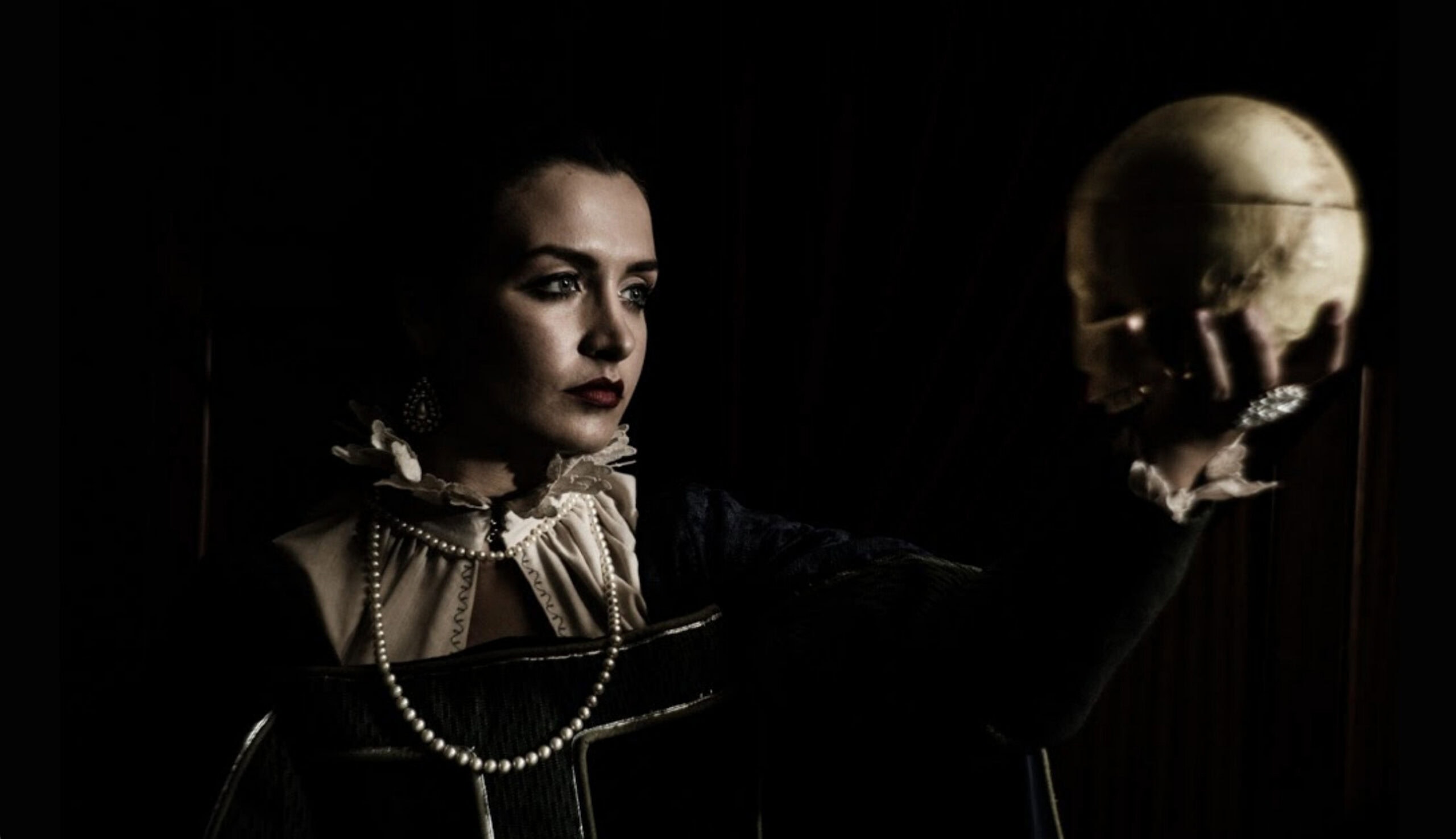
The Wicked Lit Collection: Halloween Theatre You Can Sink Your Teeth Into
Explore the collection of nineteen Wicked Lit plays adapted from short horror literature currently available for licensing from Concord Theatricals for your school, theatre or site-specific venue, as described by co-founder of Unbound Productions and playwright, Jonathan Josephson.
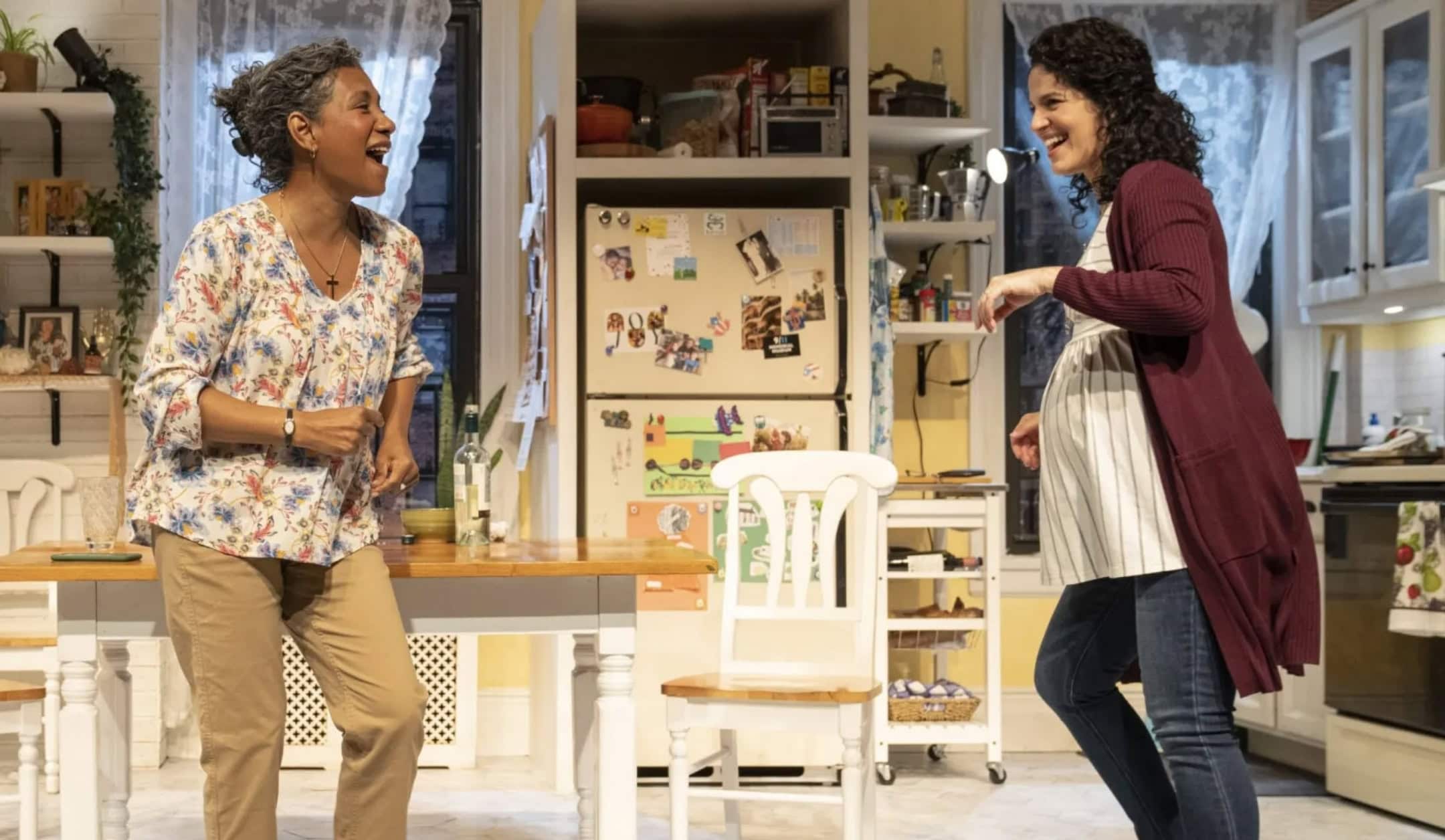
Shows About Sisters
Whether supportive, competitive, annoying, endearing or even strained, the bond of sisterhood is fascinating and full of depth for actors to examine when bringing their stories to life. Explore the relationship between sisters with these shows available from Concord Theatricals.
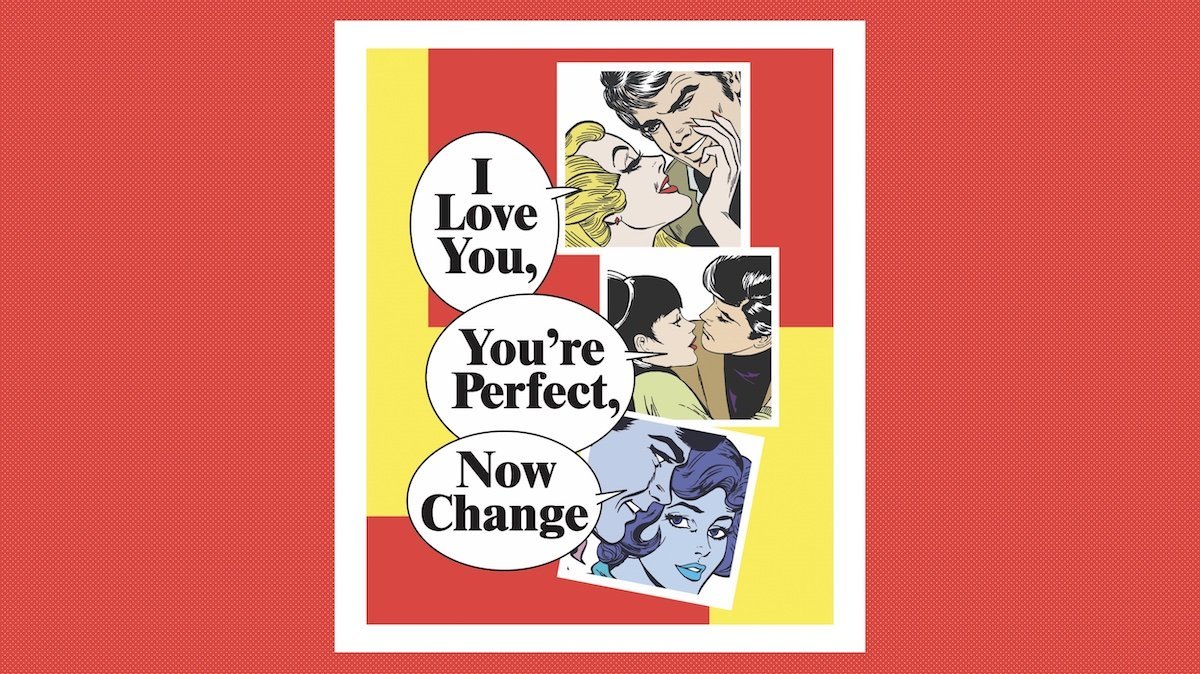
“God’s Best Joke”: A Conversation with the Creators of I Love You, You’re Perfect, Now Change
I Love You, You’re Perfect, Now Change is celebrating its 30th anniversary! Creators Joe DiPietro and Jimmy Roberts discuss the show’s creation, history and enduring success.